Folklore ·
Echoes of the Empty Ward: The Haunting of Princeton Hospital
There are places in Florida where the air feels thick with stories—where the humidity clings not just to the skin, but to the past itself. Tucked away on Mercy Drive in Orlando, the old Princeton Hospital, later renamed ...
By Rebecca "Madam Chronicler" Ryan
There are places in Florida where the air feels thick with stories—where the humidity clings not just to the skin, but to the past itself. Tucked away on Mercy Drive in Orlando, the old Princeton Hospital, later renamed Lakeside Hospital, is one of those places.
By day, it’s an aging medical building, quiet and unassuming. But by night, locals swear the air shifts. Empty wheelchairs move on their own. Lights flicker in locked rooms. And in one long corridor, a pale figure with hollow, black eyes is said to stare through the glass.
What follows is the story of that building — part history, part haunting, and entirely unforgettable.
The Forgotten Hospital
Before it was known as Lakeside Hospital, the facility began as Princeton Hospital, a mid-century medical center designed to handle psychiatric and behavioral health patients. Its exact founding date has faded into the yellowed corners of public record, but by the late 20th century, it had already earned a reputation — not for the paranormal, but for the intensity of the lives and illnesses it contained.
Nurses once described the third floor as a “lock-down unit.” The fluorescent lights hummed overhead day and night. Patients with restless energy paced the halls while others sat silent, staring out of narrow windows barred for their safety. Some never left.
By the early 2000s, the hospital changed names — Lakeside Hospital — as management shifted and mental health care evolved. Some wards were shut down, sealed off, and forgotten. The second and third floors were eventually closed to patients. And that’s when the stories began.
Night Shift: The First Whisper
In the summer of 2011, a hospital technician—whose account was later published on the blog PSI Researcher—was working the night shift when she was sent upstairs to collect medical charts from the third floor.
She described the moment she stepped off the elevator:
“The hallway was dark except for a single fluorescent light at the far end. The air was still, like it hadn’t been disturbed in years.”
The doors at the end of the hall were locked—standard procedure for an unused floor. She approached, feeling that prickling awareness that she wasn’t alone. Then came three sharp knocks on the other side of the door.
Bang. Pause. Bang. Pause. Bang.
She froze. The floor was empty. No patients. No staff. No movement.
The technician reported the incident to security. Together, they checked the surveillance footage from the hallway camera. What they saw made her stomach turn.
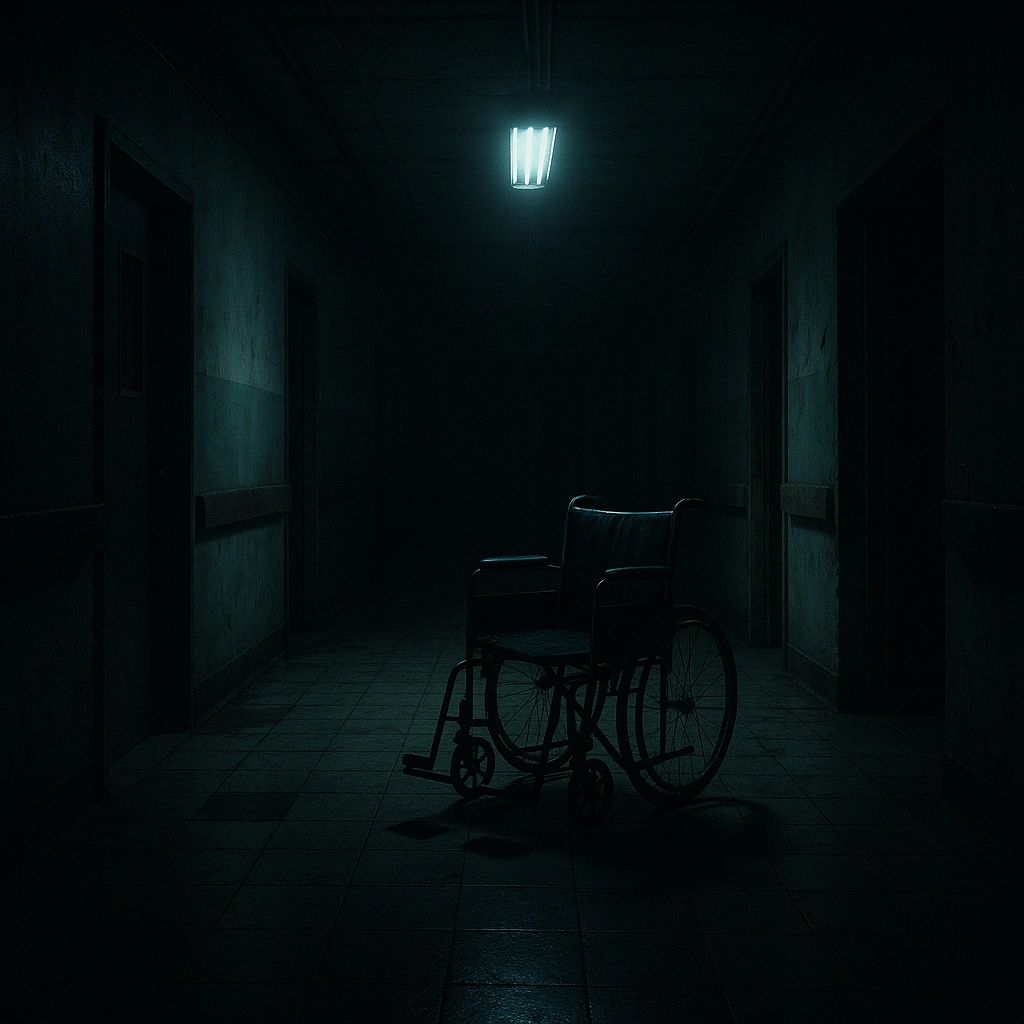
At the exact time of the knocking, the lights on the third floor flickered on and off, though the switch panel was inside the locked ward. Then, in the corner of the frame, a wheelchair rolled slowly across the hallway — by itself.
“My friend had told me of several events that were not only legend, but fact,” she later wrote. “And after that night, I believed her.” (Source: “Legend of a Haunted Psychiatric Hospital,” PSI Researcher, 2011)
The Wheelchair in the Dark
Years later, a security guard who worked nights at Lakeside Hospital told his own story. It began with a routine patrol through the second floor — another wing long out of service.
The corridor lights had been left off, so he walked by flashlight. Dust hung in the air like fog. The smell of antiseptic lingered even after years of disuse.
Halfway down the hallway, his light caught on something metallic.
A wheelchair.
It was positioned perfectly in the center of the hall, facing him. He radioed another guard, asking if anyone had moved equipment recently. The answer came back: no one had been on that floor for weeks.
Then, the sound of wheels.
Slow. Uneven. Rolling toward him.
The flashlight beam quivered as he took a step back. The chair rolled several feet forward, then stopped. The silence that followed was so heavy it felt alive.
He locked the floor and refused to patrol it again alone.
(Accounts compiled from PSI Researcher, HauntedPlaces.org, and FloridaHauntedHouses.com.)
The Girl with the Hollow Eyes
No single legend has defined the Princeton Hospital haunting more than the girl with hollow eyes.
The earliest known version of this story appeared in local ghost forums in the early 2000s and was later collected by HauntedPlaces.org. Witnesses describe her as a young woman in a faded hospital gown, her eyes dark and empty — not missing, but voids, “like glass marbles filled with ink.”
One former nurse said she appeared near the nurses’ station on the third floor. Another claimed to have seen her reflected in a glass observation window — standing directly behind her. When she turned, no one was there.
A group of urban explorers claimed they filmed the same figure one night in 2017 while walking through the abandoned corridor. Their video, later removed from YouTube, allegedly showed a faint outline of a woman stepping into view before the camera cut out.
No one knows who she is. Some say she was a patient who died during electroshock therapy in the 1960s. Others insist she’s a manifestation of collective trauma — a symbol of the suffering contained within those walls.
Either way, her story endures. She is the face of the haunting. Or rather, the lack of one.
A Building That Breathes
Standing inside the old hospital today feels like stepping into another time. The walls are painted in layers — pale green under sterile white, under the faint brown of water stains.
Dust covers the tiles. A single rolling cart remains near the elevator, draped in a sheet like a forgotten ghost.
Visitors often describe the air as heavy, like the building itself is breathing. The pipes knock. The lights buzz. The air vents sigh.
And yet, those who believe in the haunting say the sounds don’t feel mechanical — they feel responsive. As if the building listens.
“The entire second floor has this charged atmosphere,” wrote a paranormal investigator for Haunted Rooms America. “It’s not the kind of fear that makes you run — it’s the kind that makes you whisper, like you’re in church.”
There are reports of muffled voices coming from patient rooms, and doors that open just enough to catch your eye. The more time you spend inside, the more the silence hums.
Theories Behind the Haunting
Skeptics point to simple explanations. Florida’s heat warps doors and expands metal. Old air ducts groan under temperature shifts. The building’s wiring is decades old — lights flicker without reason. Wheelchairs roll on uneven floors.
But believers argue that not every sound, every motion, can be blamed on physics.
To understand why Princeton Hospital became so infamous, you have to understand its emotional history.
Psychiatric hospitals carry unique weight. They are places where pain is hidden — where the mind’s suffering leaves no visible scar. In the mid-20th century, mental health treatments were harsh, sometimes inhumane: isolation rooms, restraints, early forms of electroconvulsive therapy. Even as methods improved, the stigma remained.
Patients came here for help. Some recovered. Others didn’t.
When such energy is concentrated in one place for decades, some say it imprints itself. Paranormal researchers call it a “residual haunting” — a replay of intense emotional events trapped in space, repeating like a broken record.
In that sense, the ghosts of Princeton Hospital may not be conscious spirits at all. They may be memories made manifest.
The Paranormal Investigations
In 2011, an independent team from PSI Researcher visited the building after obtaining permission to film in one unused section. Their report describes faint electromagnetic fluctuations on the third floor and several unexplained temperature drops — as much as 15 degrees in a single room.
One investigator wrote that when she entered the ward, her audio recorder picked up faint whispers:
“Help me.” “Still here.” “Don’t go.”
Skeptics later suggested the sounds came from radio interference or passing cars outside. But the team noted the windows had been boarded shut.
Local enthusiasts from Haunted Rooms America and FloridaHauntedHouses.com have since included the site in their lists of “Florida’s Most Haunted Hospitals.” Each retelling adds new layers — new details, new voices — like echoes bouncing through time.
A Visit to Mercy Drive
I visited the site one overcast morning in late October, not to hunt ghosts but to feel the atmosphere for myself.
The building sits on a quiet street just off Mercy Drive — an ironic name, considering its haunted past. The structure itself is a patchwork of eras: old brick, weathered concrete, modern siding grafted on through renovations. A faded sign still reads Lakeside Hospital in blue lettering.
I didn’t go inside — much of it is off-limits without permission — but I stood close enough to see the dark windows of the upper floors. They looked empty, but somehow aware.
The wind picked up, carrying the faint sound of metal — a loose sign creaking against its frame. For a moment, it sounded like a wheelchair wheel turning.
I couldn’t help but imagine that technician back in 2011, standing alone in that same silence, hearing the same sound — and wondering if something unseen was still at work inside.
The Ghost as Memory
Haunted places aren’t just about ghosts; they’re about memory. Princeton Hospital stands as a mirror — reflecting what we fear, what we’ve forgotten, and what we try not to see.
The hollow-eyed girl may not be real flesh and bone, but she represents the thousands who passed through those wards unseen, unheard, unhealed. The moving wheelchair might be a coincidence, or it might be the hospital reminding us that the stories of its patients still move through its corridors.
Every haunting, in some way, is about remembrance.
“It’s not just about being scared,” one former nurse told a local historian in 2018. “It’s about feeling that someone, or something, doesn’t want to be forgotten.”
In that sense, the haunting of Princeton/Lakeside Hospital isn’t a ghost story. It’s a legacy.
Epilogue: The Empty Corridor
Night falls quickly in Orlando. The city glows with neon — theme parks, hotels, restaurants — but down on Mercy Drive, the lights fade earlier.
Inside the old hospital, the air grows still.
A single wheelchair rests at the far end of a hallway. A faint hum fills the silence. Somewhere, a light flickers on for a moment, then goes dark.
And if you stand long enough, some say you’ll hear it — the soft roll of wheels on tile, echoing through the dark.
Bibliography
- Blackwell, Jessica & Spence, David. “Legend of a Haunted Psychiatric Hospital (Part Two).” PSI Researcher (blog), July 1, 2011. https://psiresearcher.wordpress.com/2011/07/01/legend-of-a-haunted-psychiatric-hospital-part-two/
- “Princeton Hospital – Lakeside Hospital | Haunted Places | Orlando, FL.” HauntedPlaces.org.
https://www.hauntedplaces.org/item/princeton-hospital-lakeside-hospital/
- “Princeton Hospital – Lakeside Hospital | Real Haunted Places in Florida.” FloridaHauntedHouses.com.
https://www.floridahauntedhouses.com/real-haunt/princeton-hospital—lakeside-hospital.html
- “Most Haunted Places in Orlando, FL.” Haunted Rooms America.
https://www.hauntedrooms.com/florida/orlando/haunted-places
- “Black Eyed Spirits Haunt Lakeside Hospital in Orlando.” BackpackerVerse.com.
https://backpackerverse.com/lakeside-hospital-orlando/
- “Princeton Hospital – Lakeside Hospital.” MapSpirits.com. Updated Nov 22, 2022. https://www.mapspirits.com/properties/princeton-hospital-lakeside-hospital-in-orlando-fl/
About the Author
Rebecca “Madam Chronicler” Ryan is a writer and researcher for The Chronicler Library. She is the co-creator of The Chronicle of Fear and The Waterline Chronicles, and a lead researcher and contributor for The Captain’s War Chronicles and The Captain’s Cellar. Her work blends myth, history, and the natural world with empathy, insight, and intellectual rigor.
Originally published at the live site .