Folklore ·
My Love of the Supernatural and Ghosts
Introduction: A Fascination That Runs Deep
By Rebecca "Madam Chronicler" Ryan
Introduction: A Fascination That Runs Deep
Some children grow up fearing the dark, convinced that shadows conceal monsters. I grew up leaning toward those shadows, curious about what might be hidden within them. My love of the supernatural—and especially of ghosts—has been with me for as long as I can remember.
It wasn’t born out of fear but from wonder, awe, and a sense of connection to things bigger than myself. Growing up in South Louisiana, right on the bayou, I was surrounded by a world where the natural and the supernatural often seemed to overlap. Mist curled low over swamp waters at dawn, owls called from cypress branches at night, and the air itself seemed to carry secrets.
In Louisiana, the supernatural isn’t a distant curiosity—it’s part of the culture, whispered about in kitchens, sung about in ballads, and woven into childhood tales. And for me, it became the heartbeat of a lifelong fascination.
Childhood on the Bayou: Where the Supernatural Was Always Close
Life on the bayou was a mix of beauty and mystery. I grew up chasing dragonflies in the tall grass, fishing from pirogues, and listening to frogs croak at dusk. But once the sun sank low and the moss-draped oaks cast long shadows, the world transformed. Nights carried the weight of things unseen—sounds that couldn’t be explained, movements just beyond the lantern light.
It was the perfect backdrop for ghost stories.
Neighbors and family members were quick to share tales that made my imagination run wild. Some spoke of spirits lingering near the water, others warned about lights in the swamp called feux follets—mischievous flames said to lure wanderers deeper until they were hopelessly lost. My grandmother swore they weren’t just swamp gas but the souls of the damned, flickering in the darkness, waiting for the curious.
And then there was the Rougarou, Louisiana’s own werewolf. Parents used its legend to keep children in line, warning us not to misbehave or wander too far at night lest the beast find us. Some said the Rougarou prowled the swamps as punishment for breaking Lent, cursed to hunt forever. For me, it wasn’t just a story—it was part of the night air itself, as real as the call of the whippoorwill.
These tales didn’t frighten me away from the dark—they pulled me deeper into it.
Ghosts as Carriers of History
Louisiana is a land heavy with history, and in that weight, the supernatural thrives. Every ghost story is tied to lives once lived, tragedies endured, and joys cut short.
Plantations carried with them spirits of enslaved people whose suffering still echoes through the land. Old cemeteries, with their raised tombs, stood like gateways between worlds. New Orleans itself felt alive with restless souls—pirates, soldiers, and even famous figures like Marie Laveau, the Voodoo Queen.
Marie Laveau, in particular, fascinated me. Even after her death in 1881, people claim to see her wandering St. Louis Cemetery No. 1, dressed in her trademark turban, watching, listening, perhaps still tending to the city she ruled spiritually for decades. As a child, hearing stories about her made me realize something profound: ghosts aren’t just random spirits—they are cultural icons, guardians of memory, embodiments of a history that refuses to fade.
The Thrill of Haunted Places
By the time I was a teenager, I couldn’t resist visiting haunted places. The thrill wasn’t about fear—it was about connection.
The French Quarter, with its wrought-iron balconies and hidden courtyards, seemed to pulse with supernatural energy. You couldn’t walk down Bourbon Street without someone offering a ghost tour, and each time, I’d be spellbound. They spoke of Lafitte’s Blacksmith Shop, haunted by the pirate Jean Lafitte himself, and of the LaLaurie Mansion, where cruel deeds left spirits crying for justice.
Closer to home, the plantations along the river had their own chilling tales. The Myrtles Plantation was said to be one of America’s most haunted homes, where the ghost of Chloe, a slave, still wandered the grounds. Even houses that never made the history books carried stories whispered only among locals—footsteps in the hallways, rocking chairs moving on their own, cold spots that seemed to breathe.
Standing in such places, I always felt the same thing: I wasn’t just a visitor in a house or cemetery. I was a guest in a story much older than myself.
Why Ghosts Comfort Me, Not Scare Me
When people ask why I’m not afraid of ghosts, I tell them it’s because I grew up with them as neighbors. In South Louisiana, spirits are part of the community. We honor them in festivals, in music, in food, and in stories.
I never saw ghosts as monsters. I saw them as people—some lonely, some angry, some protective—but always human at their core. They reminded me that death doesn’t erase us. It transforms us.
The idea of ghosts comforts me because it means that love, memory, and presence survive the grave. The supernatural is proof that we are never truly alone.
Science Meets the Supernatural
Even though I grew up steeped in folklore, my curiosity also leaned into science. I was captivated by the way investigators used EMF detectors, EVP recorders, and infrared cameras to chase whispers and shadows.
Part of me still dreams of bringing that equipment to the bayou at night—setting it up under the cypress trees, waiting to catch the faintest voice, the softest flicker of energy. The feu follet could be explained away as swamp gas, sure—but what if it wasn’t? What if science one day proves the old legends true?
Skeptics may scoff, but Louisiana taught me something vital: mysteries are worth exploring, even if answers remain elusive.
My Own Paranormal Experiences
Growing up where I did, I didn’t just hear ghost stories—I lived them.
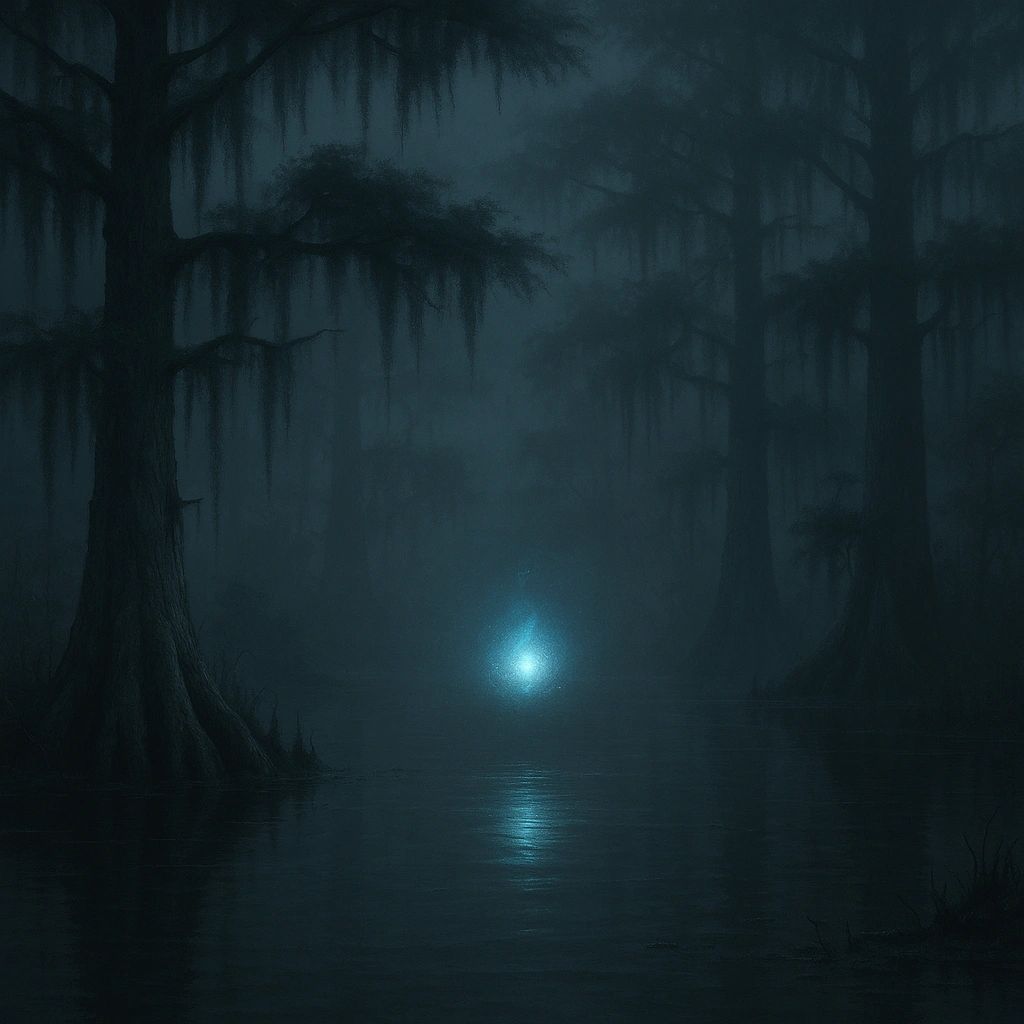
One evening, walking home along the bayou road, I saw a faint blue light floating just above the water. It wasn’t a boat and it wasn’t a flashlight. It pulsed softly, drifting forward as though beckoning me. My grandmother’s warning rang in my ears: feu follet. I didn’t follow, but I couldn’t shake the feeling that something intelligent lingered in that glow.
At my aunt’s old house, I woke one night to hear boots pacing across the wooden porch. When I opened the door, there was no one—but the footsteps kept echoing, slow and deliberate, before fading into silence.
Were these tricks of the mind? Maybe. But to me, they felt like gifts—reminders that the veil is thin on the bayou, and sometimes, the other side brushes against us.
Ghosts in Literature, Folklore, and Culture
The supernatural isn’t just local—it’s global. But Louisiana folklore gave me my foundation.
The Rougarou, with his glowing eyes and cursed howl, embodied our fear of the swamp at night. The feu follet warned of curiosity’s dangers. Marie Laveau showed me that power and presence linger beyond the grave.
From there, my love expanded outward. I devoured Gothic novels, Japanese tales of yūrei, and Mexican legends of La Llorona. But no matter how far the stories came from, they all seemed to echo the same truth: humanity has always needed ghosts.
Ghosts are our way of refusing to forget. They are our way of saying: life matters, memory matters, love matters—even after death.
The Paranormal Community
Loving ghosts connected me with others who felt the same pull. Ghost hunters, storytellers, folklorists, and skeptics all share the same stage. In Louisiana, ghost tours, Voodoo shops, and swamp legends aren’t just tourist traps—they’re living traditions.
Walking through the French Quarter at night, hearing tales of restless pirates and tragic ladies, I felt like part of a secret club. Not a club built on fear, but on curiosity, reverence, and awe.
Why Ghosts Matter
For me, ghost stories are more than entertainment. They’re history. They’re culture. They’re a way of keeping the past alive.
They remind us to respect the dead. They remind us that some things—love, trauma, memory—are too powerful to fade. They push us to wonder about what lies beyond and to accept that not everything needs neat answers.
On the bayou, the supernatural isn’t a fringe belief—it’s woven into the rhythm of life. And it matters deeply.
Haunted Dreams: My Bucket List
Though I’ll always carry Louisiana’s legends in my heart, I dream of exploring haunted places across the world.
- The Catacombs of Paris, with their endless tunnels lined with bones.
- The Tower of London, haunted by centuries of kings and queens.
- Edinburgh Castle, layered with soldiers and prisoners.
- The Winchester Mystery House, a labyrinth for the restless dead.
Each destination is a chance to step into someone else’s story, to listen, to feel, to wonder.
Conclusion: Living with the Mystery
Growing up in South Louisiana taught me that the supernatural isn’t separate from life—it’s part of it. The bayou, with its mist and mystery, raised me on legends of the Rougarou, lights of the feu follet, and whispers of Marie Laveau. Those stories shaped me into someone who doesn’t just believe in ghosts but loves them.
My passion isn’t about proof. It’s about embracing wonder, honoring the past, and finding comfort in the unseen.
So yes, I love the supernatural. I love ghosts. I love the way they linger in our culture, in our songs, in our land. I love the way they connect me to my Louisiana roots.
And maybe, when my time comes, I’ll stay behind too—another ghost on the bayou, flickering like a firefly in the night, waiting to whisper to the next curious child who dares to lean into the shadows.
Bibliography
- Ancelet, Barry Jean. Cajun and Creole Folktales: The French Oral Tradition of South Louisiana. University Press of Mississippi, 1994.
- Brandon, George. Santeria from Africa to the New World: The Dead Sell Memories. Indiana University Press, 1997.
- De Caro, Frank, ed. Louisiana Folklore Miscellany: Ghosts, Rougarou, and Other Supernatural Legends. LSU Press, 1986.
- Gomez, Michael Angelo. Ghosts of New Orleans. History Press, 2010.
- Long, Carolyn Morrow. A New Orleans Voudou Priestess: The Legend and Reality of Marie Laveau. University Press of Florida, 2006.
- Smith, Katherine. Haunted Bayou: Louisiana Ghost Stories. Pelican Publishing, 2001.
About the Author
Rebecca “Madam Chronicler” Ryan is a writer and researcher for The Chronicler Library. She is the co-creator of The Chronicle of Fear and The Waterline Chronicles, and a lead researcher and contributor for The Captain’s War Chronicles and The Captain’s Cellar. Her work blends myth, history, and the natural world with empathy, insight, and intellectual rigor.
Originally published at the live site .