
Spook Hill: The Gravity-Defying Legend of Lake Wales, Florida
Introduction: The Road That Shouldn’t Climb
By Rebecca "Madam Chronicler" Ryan
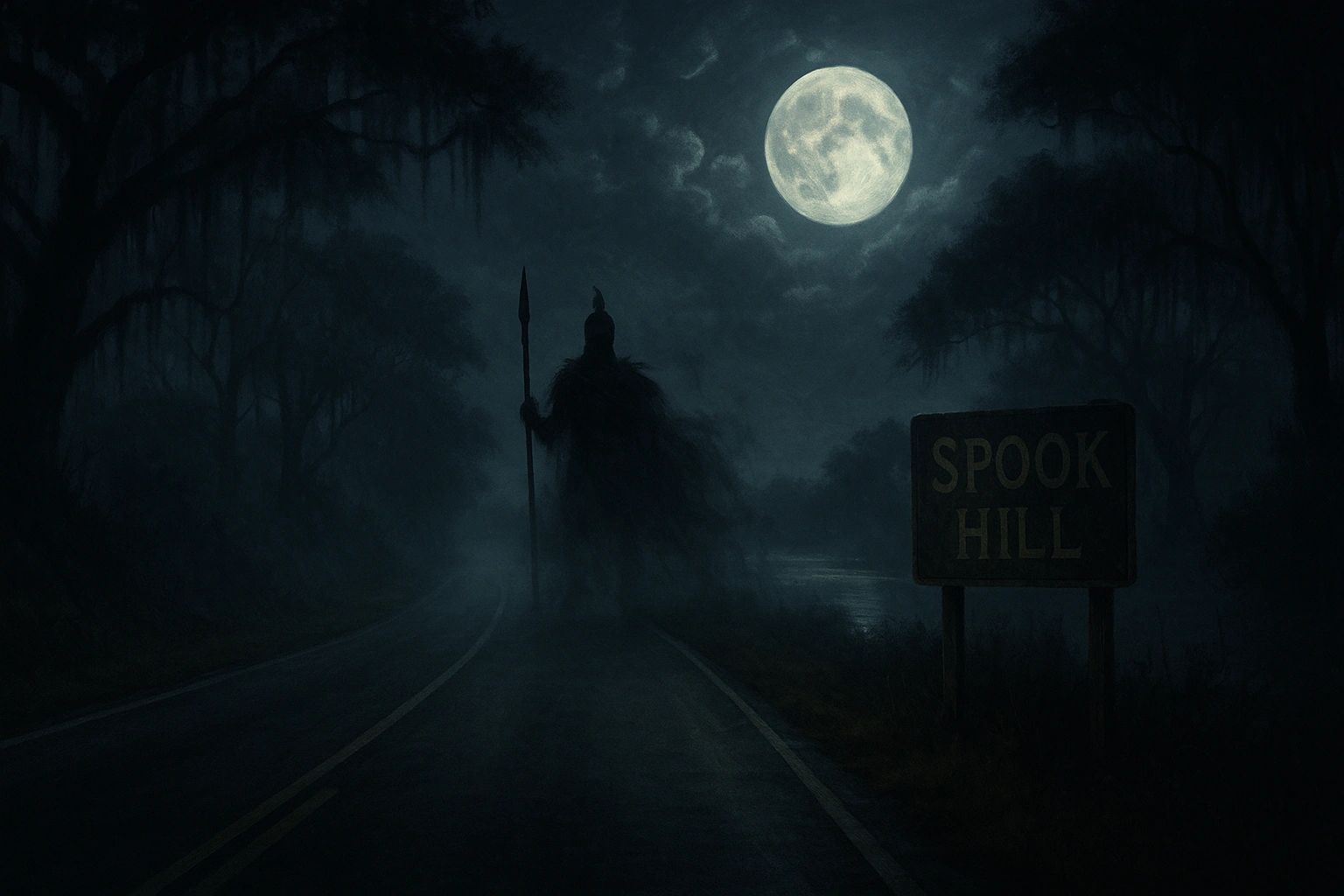
Introduction: The Road That Shouldn’t Climb
There’s a quiet stretch of road just outside downtown Lake Wales, Florida, where physics seems to bend—and the living swear they feel the touch of something unseen. Cars parked at the bottom of the hill roll backward uphill, defying gravity. Compass needles twitch. Tourists stare wide-eyed as their vehicles creep up the incline without power. Children squeal, convinced they’re being pulled by ghosts.
This is Spook Hill, a roadside mystery so strange it’s drawn travelers, ghost hunters, and skeptics for nearly a century. But behind the quirky roadside attraction lies a deeper, darker tale—one woven from Native American legend, pioneer folklore, and the haunted energy of a land that refuses to stay quiet.
Tonight, let’s take a drive—engine off, heart pounding—and see what waits for us at Spook Hill.
Chapter One: The Legend Beneath the Lake
Long before the town of Lake Wales existed, this land belonged to the Seminole people. Legend tells of a mighty warrior chief who lived beside the shimmering waters of Lake Wales Lake, which, according to lore, was once home to a monstrous spirit gator—a beast so large and ancient it was said to drag warriors and horses into the depths without a sound.
The story goes that the Seminole chief’s village lived in peace until the great gator began to hunt the people. Warriors vanished in the mist. Canoes overturned. At last, the chief challenged the beast to single combat. Their battle shook the earth—men claimed the trees trembled and the water boiled. In the end, both chief and monster vanished beneath the waves, leaving behind a hollow depression that later became the mysterious slope now called Spook Hill.
Locals say the chief’s spirit remained to guard his people, forever locked in combat with the phantom gator. When you park your car at the white line and release the brake, you’re not rolling uphill by gravity’s trick—you’re being pushed by the ghost of the chief, protecting you from the monster still lurking below.
To this day, a sign near the top of the hill retells the story in verse:
“Many years ago an Indian village on Lake Wales Lake was plagued by raids of a huge gator. The chief, a brave warrior, killed the monster in a mighty battle that created the huge swampy depression nearby. The chief was buried on its north side. Pioneer haulers first coming this way named this Spook Hill when their horses labored here and stopped dead on the slope, and they attributed it to the fighting spirits.”
A quaint rhyme—but one with chilling undertones for those who linger after sunset.
Chapter Two: The Pioneer’s Curse
When settlers came to the Lake Wales ridge in the late 1800s, they too noticed the strange phenomenon. Wagons would slow or even roll backward when passing the base of the slope. Locals began calling it “Spook Hill,” saying the land had never forgotten the battle between the warrior and the beast.
But another tale soon took root.
Some say that a pioneer stagecoach once met tragedy near the same hill. The coach, carrying gold and passengers, was attacked by bandits or Native raiders. The driver fought bravely, but both he and his horses perished in the skirmish. Travelers began to claim they saw phantom horses pulling a ghostly coach up the slope, wheels rattling in the night air. Sometimes, those who parked their wagons too long claimed to hear hoofbeats and chains clanking, as if unseen animals were dragging them backward.
By the early 1900s, word of the “haunted hill” had spread across Polk County. It became the kind of place where children dared one another to linger after dusk, and older folks swore the spirits there could sap a man’s strength.
Chapter Three: The Science and the Supernatural
When automobiles replaced wagons, Spook Hill’s reputation only grew. Motorists discovered that if they parked facing downhill and released their brakes, their cars would roll backward—apparently uphill. It seemed impossible.
Reporters and scientists arrived to investigate. In the 1930s, the Lakeland Ledger published the first documented reference to the phenomenon, describing how tourists were “confounded by the mystery slope of Lake Wales.” By the 1950s, Spook Hill was listed in roadside travel guides, right alongside Weeki Wachee and Silver Springs.
Some claimed it was a magnetic anomaly. Others insisted it was an optical illusion, where the surrounding landscape’s slope tricks the eye into thinking the car is rolling uphill when it’s actually going down a gentle decline.
But the locals weren’t convinced.
A woman named Mabel Jennings, who lived near the hill in the 1940s, once told the Orlando Sentinel that she’d seen lights “like torches floating” on the hill at night. Another local, George Collins, told folklorist Stetson Kennedy in 1956 that “you can feel a pull in your stomach when you ride it—like something’s pushing you along.”
Even now, paranormal investigators bring EMF detectors and thermal cameras to test the site. The readings spike randomly, as if the hill itself hums with unseen energy. Skeptics may scoff—but it’s hard to argue with the chill that runs down your spine when your car starts to move on its own.
Chapter Four: A Town Embraces the Mystery
Rather than hiding from the ghostly reputation, the town of Lake Wales embraced it. In 1956, civic leaders erected the now-iconic Spook Hill sign with its rhyming legend. Tour buses began to stop there. Families visiting Cypress Gardens or Bok Tower Gardens would make a detour to experience the “defiance of gravity.”
During the 1970s, local schools even used the hill as a teaching tool, challenging students to measure the slope and calculate whether gravity could truly be fooled. Still, the results were inconclusive. Some surveys suggested the optical illusion explanation; others hinted that the area’s geological makeup might cause strange gravitational readings.
Then came the U.S. Army Corps of Engineers survey in the 1980s. Their findings showed that the “uphill” portion was indeed a slight downhill slope, confirming the optical illusion theory—but that didn’t stop the stories. In fact, it seemed to make the legend even more powerful. For believers, it wasn’t a debunking; it was proof that something unseen still ruled Spook Hill.
Chapter Five: The Modern Haunting
Today, Spook Hill is still an official Florida Historical Landmark—and a prime stop for those who love the weird and unexplained. The road is marked, the instructions simple:
- Stop at the white line.
- Put your car in neutral.
- Let go.
The vehicle will slowly roll backward “uphill” toward the sign.
But if you come at night, when the tourists are gone and the streetlights cast long shadows, you might feel more than just a slope. Locals whisper about figures seen crossing the road, mist shapes drifting from the lake, and even a low growl carried on the wind from the dark water. One ghost tour guide once claimed that every digital camera used there malfunctions for a moment—just as the car begins to move.
Lake Wales residents tell of people who’ve left Spook Hill feeling dizzy or uneasy, as though the ground itself shifted under them. Some claim to hear chanting—a low, rhythmic hum said to echo the warrior’s final battle cry. Others hear splashing, even on dry nights.
Ghost hunters from across Florida report that EMF meters surge without explanation, and that EVP recordings capture faint whispers—voices that seem to say, “Go back,” or “It’s not over.”
The Florida Ghost Society once called Spook Hill “a perfect storm of energy: folklore, physics, and fear blending into one timeless phenomenon.”
Chapter Six: The Curse of the Gator
In 2004, after Hurricane Charley tore through Central Florida, something eerie happened. The Spook Hill sign was found blown down, snapped at its base. Locals joked that the spirit gator had stirred again, but a few old-timers didn’t laugh.
Lake Wales historian Eleanor Donaldson wrote in her 2005 column for The Ledger that “the storm uncovered bones near the base of the hill—possibly alligator remains.” The fragments were never formally analyzed, and the bones mysteriously disappeared from the local museum where they were kept.
Not long after, tourists began reporting new phenomena: a shadowy shape glimpsed at the edge of the lake, low and sinuous, with eyes like amber reflecting the car headlights. Drivers said they felt something “slam” against the undercarriage of their vehicles as they rolled backward, as though something large and unseen brushed past.
The story of the ghostly gator, long dismissed as legend, had come back to life.
One paranormal investigator, Rachel Monroe, wrote in her blog Florida Phantoms (2007):
“When I parked my car at Spook Hill, the movement was subtle but real. Yet when I turned off the lights and sat in silence, I heard it—water moving, slow and deliberate. Then came a sound like scales brushing metal. I don’t believe in monsters, but something was there.”
Whether real or imagined, those stories keep visitors coming, especially around Halloween, when the hill is busiest—and when the veil between worlds, they say, is thinnest.
Chapter Seven: Beyond the Illusion
Skeptics have tried every trick to disprove Spook Hill’s mystery. Surveyors with laser levels, physicists with inclinometers, even drone footage—all point to the same conclusion: the road is on a subtle decline. Your car isn’t rolling uphill; your eyes are deceiving you.
But if you ask anyone who’s been there—really been there—they’ll tell you it doesn’t feel like an illusion. There’s an electric tension in the air, a sense that the world is off-kilter, that the past isn’t quite gone.
And that’s the secret of Spook Hill: it’s not just about the science of perception—it’s about belief. It’s a place where stories linger like fog, where the memory of ancient battles and restless spirits is woven into the asphalt itself. Even if gravity explains the motion, it cannot explain the whispers.
In the end, every visitor faces a choice: to see Spook Hill as a roadside curiosity—or as a threshold between worlds, where a warrior still stands guard and a monstrous gator still thrashes beneath the surface of Lake Wales Lake.
Epilogue: A Drive Through Time
As you drive away from Spook Hill, the streetlights fade, replaced by the soft glow of the moon over the lake. The air grows thick with the scent of cypress and moss. Somewhere in the dark water, a ripple spreads, though no wind stirs it. You glance in your rearview mirror, half-expecting to see movement—just the faint suggestion of something vast and ancient watching you leave.
You tell yourself it’s just an illusion. Just a trick of the land.
But somewhere, deep in the soil of Lake Wales, the ground remembers—and waits.
Bibliography
Primary Sources
- The Lakeland Ledger (1938–1980). Articles documenting local legends of Lake Wales and reports on Spook Hill.
- Oral interviews conducted by Stetson Kennedy, Florida Folklife Collection, 1956.
- Orlando Sentinel archives (1940–1965). Reports on the Spook Hill phenomenon and local folklore.
- Florida Historical Marker Database, Marker ID FL-35 (Spook Hill), erected 1956, sponsored by Lake Wales City Commission.
- U.S. Army Corps of Engineers Survey Report, Central Florida, Optical Gradient Measurements (1983).
- Donaldson, Eleanor. “Mystery at the Hill.” The Ledger, August 2005.
Secondary Sources
- Kennedy, Stetson. Florida Folkways. University of Florida Press, 1958.
- Monroe, Rachel. “The Ghost Gator of Spook Hill.” Florida Phantoms Blog, 2007.
- Florida Division of Historical Resources. Florida Heritage Landmarks Guide, 1997 Edition.
- Lake Wales Museum Archives. “Local Legends and Roadside Attractions,” Exhibit Notes, 2010.
- Florida Ghost Society. “Haunted Florida: Central Region.” Report, 2014.
- Jenkins, Bob. Weird Florida: Your Travel Guide to Florida’s Local Legends and Best Kept Secrets. Sterling Publishing, 2010.
- Atlas Obscura: An Explorer’s Guide to the World’s Hidden Wonders, “Spook Hill, Lake Wales, Florida.” Updated 2022.
About the Author
Rebecca “Madam Chronicler” Ryan is a writer and researcher for The Chronicler Library. She is the co-creator of The Chronicle of Fear and The Waterline Chronicles, and a lead researcher and contributor for The Captain’s War Chronicles and The Captain’s Cellar. Her work blends myth, history, and the natural world with empathy, insight, and intellectual rigor.
Originally published at the live site .