
The Ghosts of Castillo de San Marcos Fort
Perched on the shores of Matanzas Bay in St. Augustine, Florida, the Castillo de San Marcos is more than just a fortress of coquina stone and colonial history—it is a place where the past whispers in the wind, shadows li...
By Rebecca "Madam Chronicler" Ryan
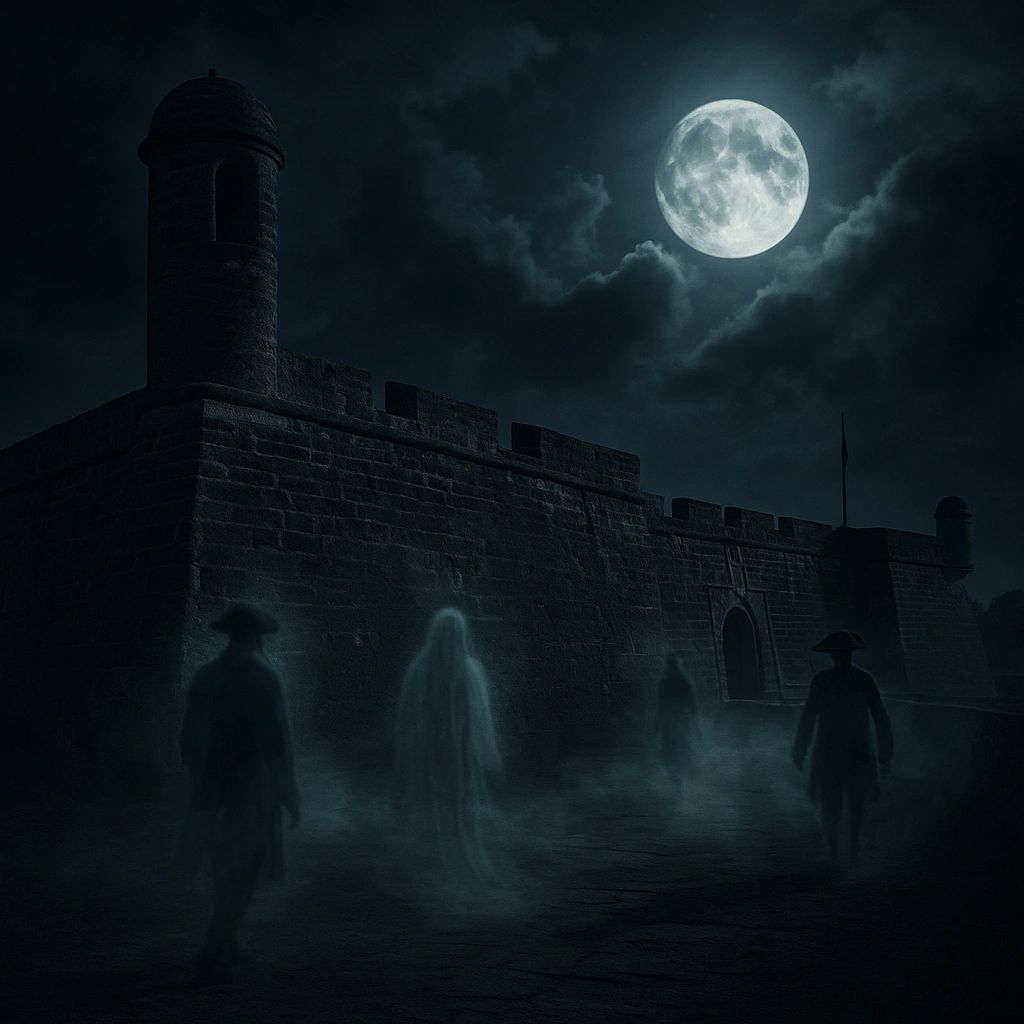
Perched on the shores of Matanzas Bay in St. Augustine, Florida, the Castillo de San Marcos is more than just a fortress of coquina stone and colonial history—it is a place where the past whispers in the wind, shadows linger in the corners, and spirits seem reluctant to leave. Built in the late 17th century by the Spanish to defend against invading forces, the fort is the oldest masonry structure in the continental United States. Its long and often violent history has made it a natural setting for ghost stories, legends, and paranormal investigations.
For centuries, tales of mysterious voices, vanishing figures, and spectral soldiers have swirled around the Castillo, earning it a reputation as one of Florida’s most haunted landmarks. Tourists, historians, and paranormal enthusiasts alike are drawn not just by its architecture and history but also by the possibility of encountering something otherworldly.
In this blog, we’ll dive into the fort’s dark past, the most famous ghost stories, and why Castillo de San Marcos continues to be a hotspot for paranormal activity.
The History of Castillo de San Marcos
The Castillo de San Marcos was constructed by the Spanish between 1672 and 1695 to defend St. Augustine from English and pirate attacks. Made of coquina—a sedimentary rock composed of seashell fragments—it has withstood sieges, cannon fire, and centuries of storms. Unlike wooden forts that burned easily, the coquina walls absorbed cannonball impacts, making the Castillo a formidable stronghold.
Throughout its history, the fort changed hands several times:
- From Spain to Britain in 1763 after the Treaty of Paris.
- Back to Spain in 1783 after the American Revolution.
- Finally to the United States in 1821 when Florida became a U.S. territory.
It has served as a military outpost, prison, and symbol of colonial power. Tragically, the fort also imprisoned Native Americans, including Seminole leaders such as Osceola, and during conflicts, it held captives under grim conditions. These layers of suffering and violence are often cited as reasons why spirits remain tied to the Castillo.
Why the Fort is Believed to Be Haunted
The Castillo de San Marcos has been a stage for war, death, and imprisonment. Soldiers died defending its walls, prisoners languished in its dungeons, and countless lives were shaped within its stone boundaries. Paranormal researchers often point to such intensity of human experience as the breeding ground for hauntings.
Key reasons include:
- Battles and Sieges – Death and trauma leave emotional imprints.
- Imprisonments – Harsh conditions caused immense suffering, particularly among Native Americans.
- Tragic Love Stories – Legends of betrayal and murder contribute to the ghostly lore.
- Longevity – At more than 300 years old, the fort has had ample time to accumulate legends.
The Most Famous Ghost Stories of Castillo de San Marcos
1. The Lovers Trapped in the Walls
One of the most chilling and popular legends is that of Colonel García Marti and his young wife, Dolores. According to legend, Dolores grew close to Captain Manuel Abela, a young soldier. Colonel Marti, consumed by jealousy, suspected an affair. When Dolores and Manuel suddenly disappeared, locals whispered suspicions—but no proof was found.
Years later, during renovations of the fort, workers allegedly discovered a hidden room sealed within the coquina walls. Inside were two skeletons chained together. Many believe these were Dolores and Manuel, entombed alive by the colonel. Visitors claim that Dolores’s spirit roams the fort, her cries echoing in the corridors.
2. The Ghost of Osceola
Osceola, a famous Seminole leader, was captured under a white flag of truce and imprisoned at the Castillo in 1837. While he was later transferred to Fort Moultrie in South Carolina, where he died, some say his spirit lingers in St. Augustine. Witnesses report seeing a proud Native American figure near the fort’s gates, vanishing when approached.
3. The Spanish Soldier on Guard
Several tourists and rangers have reported seeing a spectral Spanish soldier standing guard at the fort’s entrance or walking the ramparts. Dressed in traditional uniform, he often appears briefly before disappearing into thin air. Paranormal investigators believe this apparition may be a soldier still bound to his eternal duty of protecting the fortress.
4. Phantom Voices and Footsteps
Countless visitors report hearing footsteps echoing in empty rooms, particularly in the dungeon areas. Some describe faint voices speaking in Spanish, moans of suffering prisoners, or even the sounds of cannon fire. During ghost tours, many have claimed to capture EVPs (electronic voice phenomena) with mysterious whispers.
5. The Lights in the Watchtower
Another common phenomenon is the appearance of strange lights in the watchtower. These glowing orbs or flickering lantern-like lights appear when no one is inside. Skeptics suggest reflections or tricks of the light, but believers think it is the spirits of soldiers continuing their nighttime patrols.
Paranormal Investigations
The Castillo de San Marcos is frequently featured in documentaries, ghost-hunting shows, and paranormal investigations. Groups using thermal cameras, spirit boxes, and EMF detectors have claimed to capture unusual readings in the casemates and dungeon areas.
Some of the most compelling evidence includes:
- Disembodied voices recorded in Spanish.
- Shadow figures caught on video moving across walls.
- Temperature drops in specific rooms.
- Unexplained lights photographed near the bastions.
Even National Park Service rangers, who maintain the site, have admitted to experiencing eerie sensations and unexplained occurrences after hours.
Cultural Impact and Ghost Tourism
St. Augustine bills itself as the most haunted city in America, and the Castillo is central to that identity. Numerous ghost tours stop at the fort, retelling its chilling stories to eager visitors. The mixture of historical fact and ghostly legend makes it a compelling attraction, drawing history buffs and thrill-seekers alike.
The tales of Castillo de San Marcos serve not just as entertainment but also as a reminder of the fort’s layered past—a past filled with triumph, tragedy, and the resilience of those who lived (and perhaps still linger) within its walls.
Skeptics vs. Believers
Not everyone is convinced. Skeptics argue that the Castillo’s ghost stories are fueled more by tourism than fact, pointing out that many of the most famous tales—such as the lovers bricked into the wall—have no solid historical documentation. Instead, they suggest natural explanations:
- Echoes and acoustics of stone chambers.
- Optical illusions caused by shadows and lights.
- Overactive imaginations during ghost tours.
However, believers counter that the sheer volume of reports, along with unexplained recordings and photos, suggests something beyond coincidence. For many, whether or not the ghosts are “real” is less important than the fact that they keep the memory of history alive.
Conclusion
The Castillo de San Marcos is more than a relic of colonial history—it is a monument to centuries of human drama, conflict, and resilience. Whether haunted by restless spirits or simply by the weight of its past, the fort continues to captivate visitors. For some, it is a place to learn about history. For others, it is a place to connect with the supernatural.
Perhaps the true haunting lies not in ghostly figures but in the realization of how much suffering and sacrifice occurred within its walls. Either way, the Castillo de San Marcos will forever be a place where the line between past and present feels thin, and where whispers of history may just be voices from beyond.
Bibliography
- Deagan, Kathleen. Fort Mose: Colonial America’s Black Fortress of Freedom. University Press of Florida, 1995.
- Griffin, Patricia C. Mullett’s Ghosts and Other Tales of Old St. Augustine. St. Augustine Historical Society, 1997.
- Historic Preservation Board of St. Augustine. The Castillo de San Marcos: A Historical Guide. U.S. Department of the Interior, National Park Service, 1985.
- National Park Service. “Castillo de San Marcos National Monument.” https://www.nps.gov/casa
- Nichols, Sandra Wallus. Ghosts of St. Augustine. Pineapple Press, 1994.
- Rauscher, William S. Haunted St. Augustine and St. Johns County. History Press, 2011.
- St. Augustine Lighthouse & Maritime Museum. Legends and Ghosts of St. Augustine. St. Augustine Publications, 2010.
About the Author
Rebecca “Madam Chronicler” Ryan is a writer and researcher for The Chronicler Library. She is the co-creator of The Chronicle of Fear and The Waterline Chronicles, and a lead researcher and contributor for The Captain’s War Chronicles and The Captain’s Cellar. Her work blends myth, history, and the natural world with empathy, insight, and intellectual rigor.
Originally published at the live site .