Folklore ·
The Haunting of the Cocoa Village Playhouse
“The past is never dead. It’s not even past.” — William Faulkner
By Rebecca "Madam Chronicler" Ryan
“The past is never dead. It’s not even past.” — William Faulkner
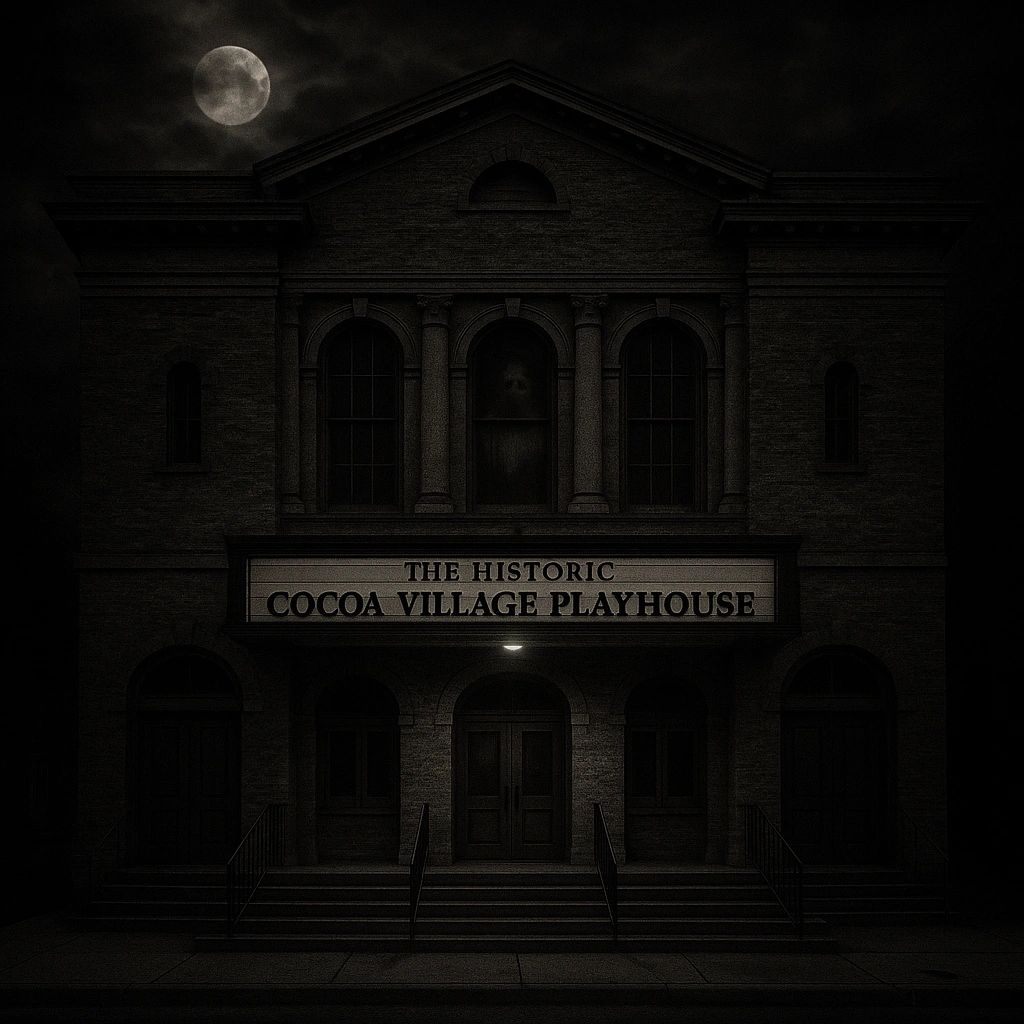
In the quiet heart of Cocoa, Florida, where the air carries the scent of the Indian River and the sound of laughter from nearby shops, stands a building with stories older than the town itself. Known today as the Historic Cocoa Village Playhouse, this grand structure is one of Brevard County’s most cherished cultural landmarks. But behind the velvet curtains and gleaming chandeliers lurks something more elusive — a haunted legacy that has captivated residents, performers, and ghost hunters alike.
I. The Origins of the Playhouse
The story of the Cocoa Village Playhouse begins long before any talk of hauntings. The theater first opened its doors on August 18, 1924, as the Aladdin Theater — a glamorous venue for silent films and vaudeville acts. It was a time when showmanship was everything and audiences came dressed to the nines for an evening of laughter, music, and escapism.
The Aladdin was the dream of local businessman H.A. Wiltfong, who wanted Cocoa to share in the golden age of cinema. Its red velvet seats and ornate plasterwork mirrored the grand movie palaces of the era. As sound films (“talkies”) emerged, the theater evolved, eventually becoming known as the State Theater in 1939 under the Sparks Theater chain.
In the 1960s, the Kent Theater Corporation renamed it the Fine Arts Theater, showing independent and art films. However, by the early 1980s, the once-beautiful building had fallen into disrepair. It sat quiet and empty, its stage dark — until Brevard Community College stepped in to save it.
In 1985, the college purchased the property for just one dollar from the City of Cocoa, launching a massive restoration campaign. After years of work, the theater reopened in 1990 as the Cocoa Village Playhouse, dedicated to community theater and the performing arts.
The Playhouse was added to the U.S. National Register of Historic Places in 1991 under its original name, the Aladdin Theater. Nearly a century after its first opening, it stands as a tribute to art, resilience, and — according to some — the supernatural.
II. Spirits Behind the Curtain
Every old theater seems to have its ghosts, and the Cocoa Village Playhouse is no exception. Stories of strange happenings began surfacing not long after the renovations began in the 1980s.
1. Joe the Caretaker
The most well-known ghost said to roam the Playhouse is affectionately known as “Joe the Caretaker.”
According to staff and longtime performers, Joe is believed to be the spirit of a handyman or custodian who once worked in the building. He’s not an angry ghost but rather a helpful one — a quiet presence keeping watch over the place he loved.
Visitors and cast members have reported hearing footsteps echoing through empty hallways, doors opening and closing on their own, and feeling the unmistakable sensation of being watched. Some even say Joe occasionally helps out, adjusting lights or closing a door that someone forgot.
One performer described it best:
“You will always feel a presence behind you here — but never one that means you harm.”
Joe’s spirit is said to linger mostly near the balcony and backstage corridors, keeping to the shadows but making his presence known when the theater grows too quiet.
2. The Legend of Daniel, the Stable Hand
Another of Cocoa Village’s oldest ghost stories predates the Playhouse itself. Before the theater was built, legend claims the site once held a livery stable and an artesian well.
According to lore, a young stable hand named Daniel was falsely accused of horse theft. In a tragic act of mob justice, Daniel was hanged near the well — an execution many believed to be unjust. Locals claimed his tears salted the water, and that his spirit remained bound to the land where he died.
Though no historical record confirms the hanging, many ghost enthusiasts believe Daniel’s spirit is still attached to the property. Some say his presence is responsible for sudden cold spots, whispering voices, or even objects moving on their own.
In one version of the story, Daniel’s ghost became so angry that the Playhouse’s director once had the building blessed to rid it of negative energy. Whether that exorcism ever took place remains a matter of debate.
3. The Darker Presences
While Joe is said to be benevolent, not all spirits of the Playhouse are as kind. Several staff members and paranormal investigators have described uneasy sensations — cold drafts, unexplained noises, and even feelings of dread in certain backrooms.
Some ghost tours claim that at least one “malevolent” entity once haunted the theater, possibly tied to Daniel’s story or other unrecorded events in its history.
During renovation in the 1980s, construction workers allegedly refused to stay after dark. Tools went missing, lights flickered, and eerie laughter echoed from the stage when no one was there. Whether these events were the result of paranormal activity or simple imagination, they left a lasting impression on those who experienced them.
III. Paranormal Activity and Common Experiences
Visitors and performers have reported a range of unexplained activity over the years, many of which follow familiar ghostly patterns:
Phenomenon Reported OccurrenceFootsteps Heard in hallways and catwalks when the building is empty.
Doors Opening/Closing Stage and balcony doors move without explanation.
Cold Spots Sudden drops in temperature, especially backstage.
Objects Moving Props and tools found in new places overnight.
Unseen Touches Sensations of being brushed or tapped on the shoulder.
Faint Voices or Whispers Heard near the balcony and dressing rooms.
Skeptics often point out that old buildings creak, air currents shift, and theater acoustics can create the illusion of footsteps. But for those who’ve felt it firsthand, logic is no match for that spine-tingling sense of being watched in the dark.
IV. Cocoa Village and the Culture of Ghosts
Rather than deny its supernatural reputation, Cocoa Village has embraced it.
The Playhouse features prominently in the “Historic Ghost Walk of Cocoa Village”, an annual event that guides participants through the town’s most haunted sites. Local guides share the stories of Joe, Daniel, and other spectral figures from Cocoa’s past.
The Playhouse also occasionally stages Halloween-themed performances, merging local folklore with the dramatic arts. From spine-chilling plays to haunted tours, it blurs the line between history and legend, between performance and haunting.
V. Why the Haunting Persists
1. The Building’s Age and Atmosphere
Old theaters naturally lend themselves to ghost stories. Their high ceilings, echoing acoustics, and dim lighting create perfect conditions for eerie sensations. The Cocoa Village Playhouse, with nearly 100 years of history, countless renovations, and hidden spaces, is the ideal stage for a haunting.
2. Emotional Energy of the Stage
Actors and ghost hunters alike often speak of “residual energy” — the emotional imprint left behind by decades of human expression. The stage has witnessed laughter, tears, and heartbreak. If emotion leaves echoes, then few places would be louder than a century-old theater.
3. Oral Tradition and Tourism
Cocoa Village is known for its historic charm, and its ghost stories are part of its cultural identity. Tales of Joe and Daniel draw visitors from across Florida. These stories pass through generations, changing slightly each time, keeping the legends alive.
4. The Theater’s Acceptance of Its Ghosts
Unlike some haunted places that shy away from their spooky reputation, the Cocoa Village Playhouse welcomes it. The theater’s management acknowledges the stories with good humor and curiosity, allowing them to enhance rather than overshadow its legacy.
VI. A Night at the Haunted Playhouse
To truly understand the haunting, imagine standing inside the Playhouse long after the final curtain has fallen.
The seats are empty, the air still. A faint smell of sawdust and paint lingers backstage. From somewhere above, a soft creak — footsteps on the catwalk.
You shine a flashlight upward. Nothing.
A door at the far end of the corridor opens slowly, its hinges whispering. You hold your breath.
Then it closes again.
The air grows colder. You sense — not see — movement behind you, a shadow flickering just at the edge of your vision. For a moment, you feel you’re not alone.
Is it Joe, making his rounds? Or Daniel, forever mourning the injustice that took his life?
You’ll never know for sure. But when you step back into the Florida night, the air feels different — lighter, as if the Playhouse itself exhaled.
VII. The Skeptic’s View
For all the chilling accounts, skeptics argue that the hauntings are a blend of psychology and architecture.
Old wooden buildings expand and contract with temperature changes. Drafts cause doors to move. Theatrical acoustics amplify distant sounds, creating the illusion of movement.
There’s also the power of suggestion. When people enter a place already known as haunted, their minds are primed to interpret any creak, shadow, or flicker of light as supernatural.
Still, even skeptics admit: not everything can be explained. Some experiences — that subtle, electric feeling of being watched — defy reason.
VIII. The Value of the Legend
Whether or not you believe in ghosts, the haunting of the Cocoa Village Playhouse has value beyond the paranormal.
Ghost stories preserve history. They give voice to forgotten figures — a handyman named Joe, a stable hand named Daniel — who might otherwise be lost to time. They foster community and curiosity, drawing visitors who might never have stepped into Cocoa Village.
And perhaps most importantly, they remind us that the past never truly disappears. It lingers — in the walls, in the air, in the stories we tell.
IX. Visiting the Playhouse
If you’re in Central Florida and curious about the supernatural, visiting the Cocoa Village Playhouse is a must.
Tips for Visitors:
- Join an official ghost walk. Cocoa Village offers guided tours that share local history and hauntings safely and respectfully.
- Be respectful of the space. It’s an active theater with a full calendar of shows — not a ghost-hunting playground.
- Stay after a performance. Many claim the building feels different once the audience leaves — as if unseen eyes are watching from the balcony.
- Bring a camera (and an open mind). Whether you capture a ghost or not, you’ll witness one of Florida’s most beautiful historic theaters.
X. Conclusion: Where Stories and Spirits Meet
The Cocoa Village Playhouse stands as more than a stage — it is a living relic, a bridge between past and present, between the world of performance and the whispers of the unseen.
Its ghosts, real or imagined, serve as caretakers of memory. They remind us that every place with history has its echoes — footsteps in empty corridors, laughter in the wings, and a curtain that never quite closes.
Perhaps Joe still wanders the balcony, ensuring everything runs smoothly. Perhaps Daniel still seeks justice beneath the old boards.
Or perhaps, as with all great stories, the haunting lives on because we need it to — to keep the past alive, to make the ordinary feel extraordinary.
Either way, one thing is certain: when the lights dim and the applause fades, the Cocoa Village Playhouse never truly sleeps.
Bibliography
- “Aladdin Theater (Cocoa, Florida).” Wikipedia. Updated 2024. https://en.wikipedia.org/wiki/Aladdin_Theater
- “Cocoa Village Playhouse – Haunted Places.” HauntedPlaces.org. https://www.hauntedplaces.org/item/cocoa-village-playhouse-aladdin-theatre
- “Ghost Stories of Brevard County.” DiscoverTitusville.com. https://www.discovertitusville.com/ghost-stories/5-cocoa-village-playhouse
- “Historic Cocoa Village Playhouse Named Among Space Coast’s Most Haunted.” SpaceCoastDaily.com, October 2023. https://spacecoastdaily.com/2023/10/ashleys-no-1-on-top-10-most-haunted-places-in-brevard-county
- “The Cocoa Village Playhouse.” FloridaHauntedHouses.com. https://www.floridahauntedhouses.com/real-haunt/the-cocoa-village-playhouse.html
- “Past and Presence Ghost Tours of Cocoa Village.” VisitCocoaVillage.com. https://visitcocoavillage.com/event/ghost-tours
- “The Historic Ghost Walk of Cocoa Village.” Evendo.com. https://evendo.com/locations/florida/cocoa-beach/attraction/the-historic-ghost-walk-of-cocoa-village
- “The Cocoa Village Playhouse Official Website.” CocoaVillagePlayhouse.com. https://cocoavillageplayhouse.com
About the Author
Rebecca “Madam Chronicler” Ryan is a writer and researcher for The Chronicler Library. She is the co-creator of The Chronicle of Fear and The Waterline Chronicles, and a lead researcher and contributor for The Captain’s War Chronicles and The Captain’s Cellar. Her work blends myth, history, and the natural world with empathy, insight, and intellectual rigor.
Originally published at the live site .