
The Haunting of the LaLaurie Mansion in New Orleans
In the heart of the French Quarter, where the air hangs heavy with the scent of magnolia and old secrets, stands one of New Orleans’ most infamous homes—the LaLaurie Mansion. Its gray stone façade looms like a sentinel o...
By Rebecca "Madam Chronicler" Ryan
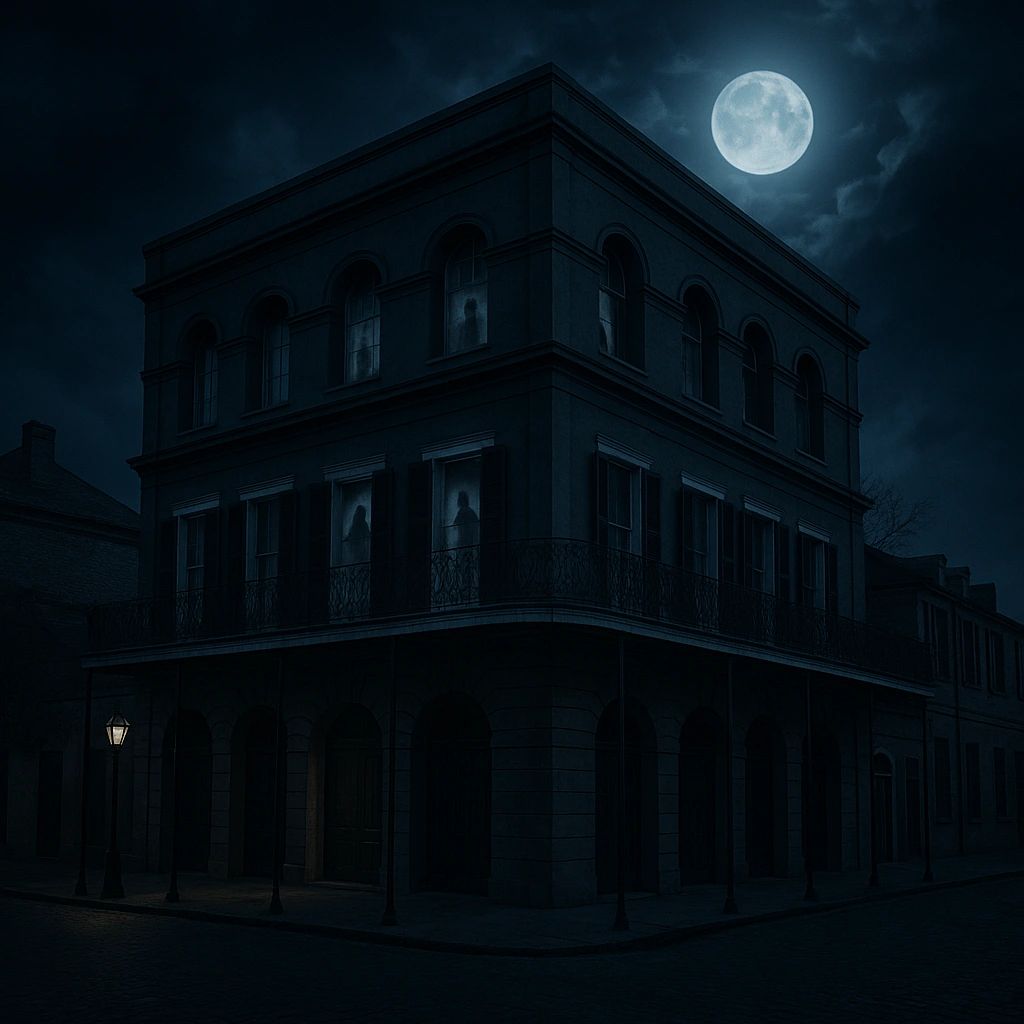
In the heart of the French Quarter, where the air hangs heavy with the scent of magnolia and old secrets, stands one of New Orleans’ most infamous homes—the LaLaurie Mansion. Its gray stone façade looms like a sentinel over Royal Street, an elegant mask concealing a history soaked in cruelty, sorrow, and restless spirits. To passersby, it is just another beautiful relic of the city’s gilded past, but to those who know its story, the mansion is a place where nightmares live behind shuttered windows.
The tale of Madame Delphine LaLaurie and her house of horrors has transcended time, becoming one of the most enduring ghost stories in America. But unlike many legends that fade into myth, the LaLaurie Mansion’s haunting is rooted in documented terror—acts so grotesque that even two centuries later, whispers still rise from its walls when the wind blows through the Quarter at night.
A City of Shadows
New Orleans has always been a city where the living and the dead coexist in uneasy harmony. It’s a place that thrives on paradox—beauty and decay, music and mourning, celebration and sorrow. The rhythm of jazz drifts through narrow streets where wrought-iron balconies sag under the weight of years, and cemeteries with their above-ground tombs keep watch over the living like marble guardians.
It was in this mystical landscape that Madame Delphine LaLaurie made her mark. A socialite, a hostess, and a woman of considerable wealth, she was the epitome of refinement in early 19th-century New Orleans society. But beneath her polished demeanor lay a darkness that no masquerade ball could disguise.
The Lady of Royal Street
Marie Delphine Macarty was born into privilege in 1787, part of a prominent Creole family. Her life unfolded like a gothic novel: three marriages, multiple estates, and a social reputation that glittered as bright as the chandeliers in her parlor. Her final husband, Dr. Leonard Louis Nicolas LaLaurie, was a physician of some repute, and together they purchased the now-infamous mansion at 1140 Royal Street in 1831.
The three-story house was one of the grandest in the city, complete with a wrought-iron balcony and a slave quarters tucked discreetly behind its walls. The LaLauries hosted lavish parties, attended by the elite of New Orleans society. Guests would marvel at the opulent furnishings, the sparkling mirrors, and Madame LaLaurie’s charm.
Yet, even then, rumors swirled. Neighbors whispered about strange sounds coming from the upper floors—screams muffled by walls too thick for comfort. They spoke of enslaved servants who seemed terrified, of sudden disappearances, and of the icy coldness that seemed to emanate from the lady of the house when no one was watching.
The Fire That Revealed the Horror
On April 10, 1834, the illusion shattered.
Fire broke out in the mansion’s kitchen, and the blaze spread quickly. Neighbors and passersby rushed to help, forming bucket lines to contain the flames. When rescuers entered the home, they were confronted not only by smoke and chaos—but by a locked door in the attic that Madame LaLaurie refused to open.
When the authorities forced it open, what they found within would scar New Orleans forever.
Inside were enslaved men and women chained, mutilated, and left to suffer unspeakable torture. Some were restrained in iron collars, others disfigured beyond recognition. The conditions were described as “too frightful to be described in detail,” and yet word spread rapidly through the city. The once-beloved Madame LaLaurie was unmasked as a monster.
A mob gathered outside her home that same night, howling for justice. They ransacked the mansion, smashing furniture, tearing curtains, and looting what remained. But Delphine LaLaurie escaped—fleeing New Orleans in a carriage as the crowd descended upon her house of horrors.
She was never seen again. Some say she made her way to Paris, where she lived out her days in exile. Others claim she returned to Louisiana under a false name, her ghostly presence ensuring she never truly left Royal Street.
A Mansion That Wouldn’t Rest
The fire gutted the mansion, but the echoes of its atrocities lingered long after the flames died. The house was eventually repaired, though many said it should have been left in ruin. Over the next decades, the LaLaurie Mansion became a revolving door of owners, none of whom stayed long. Strange occurrences plagued them all—objects moving on their own, footsteps echoing down empty halls, and the unmistakable sound of chains dragging across the floor.
One early tenant, who turned the property into an apartment building, reported that his tenants were tormented by ghostly wails and phantom screams. Children spoke of seeing figures bound in shadow. Workers claimed unseen hands would strike them as they tried to make repairs.
In the late 19th century, a man living in one of the rooms was found murdered. Witnesses said they heard him screaming the night before, shouting that something was inside with him—something not human. His body was discovered mutilated, and though no one could explain what had happened, locals whispered that the spirits of the enslaved had claimed vengeance at last.
The Voices of the Dead
Visitors to the LaLaurie Mansion today often report cold spots and feelings of overwhelming sadness as they approach the upper floors. Paranormal investigators have captured faint moans and disembodied voices—some speaking in French, others in anguished cries too distorted to identify.
One of the most reported apparitions is that of a young girl, believed to be Lea, a child enslaved by Madame LaLaurie. According to legend, Lea once accidentally pulled Madame’s hair while brushing it, enraging the woman so violently that she chased the girl through the house with a whip. In her terror, Lea leapt from the balcony, her body crashing onto the street below.
Even now, people claim to see her ghostly figure standing on the balcony, her dress fluttering in a wind that doesn’t exist. At night, some say she peers down at passersby, her eyes filled with silent pleas for help.
Another common encounter involves phantom footsteps and the rattling of chains in the attic. Tour guides recount stories of visitors fainting or fleeing the building after feeling unseen hands brush their shoulders or hearing whispers calling their names.
The Mansion Through the Ages
Over the years, the LaLaurie Mansion has taken on many identities. It was once a girls’ school, where students reported eerie presences and sudden fits of crying without reason. Later, it became a boarding house, where tenants described waking in the middle of the night to find pale figures standing at the foot of their beds.
In the 1870s, it even served as a furniture store. The owner complained that every morning, his stock was inexplicably covered in a dark, foul-smelling liquid—as though something unseen was trying to destroy his business. No amount of cleaning could stop it, and he eventually abandoned the building in fear.
The house fell into disrepair, and for much of the 20th century, it stood as a brooding relic of New Orleans’ haunted past. Even those who lived nearby crossed the street to avoid passing directly in front of it after sunset. Taxi drivers refused fares to the address, and local children dared one another to touch its door and run.
Nicolas Cage and the Curse of Ownership
In 2007, the LaLaurie Mansion made headlines again when actor Nicolas Cage purchased it for $3.45 million. A self-proclaimed aficionado of the macabre, Cage reportedly bought the mansion to inspire his writing. He joked that he wanted a house “that would scare me,” but what followed was anything but humorous.
Within two years, Cage lost the mansion to foreclosure, along with several other properties, amid financial troubles. Locals whispered that the curse of LaLaurie had struck again—that no one could own the house without misfortune befalling them. Cage himself later remarked that the mansion was “the most haunted house in America,” and he refused to elaborate further.
Modern-Day Encounters
Today, the LaLaurie Mansion remains privately owned and closed to the public, but that hasn’t stopped people from feeling its eerie pull. Ghost tours pause outside its gates nightly, their guides recounting the horrors that unfolded there. Visitors often describe sensations of nausea, dizziness, or inexplicable sadness as they stand before the house.
Photographs taken of its windows sometimes reveal pale faces peering out, even though the building is unoccupied. In the quiet hours of early morning, security guards and nearby residents report lights flickering on inside, followed by faint screams that vanish with the dawn.
Even those skeptical of the supernatural admit that there is something oppressive about the house—an energy that seems to seep from the very bricks. It’s as if the mansion itself remembers, replaying its trauma in endless loops.
The Psychology of Evil
What is it about the LaLaurie Mansion that continues to captivate and terrify? Some believe it’s not just a haunting but a manifestation of collective guilt—a city forced to confront the darkness of its own history. New Orleans was built on the backs of the enslaved, and Madame LaLaurie’s atrocities serve as a grotesque reflection of that cruelty taken to its most extreme form.
Others argue that the house acts as a psychic sponge, absorbing the pain, fear, and anger of those who suffered within its walls. This theory aligns with a common belief among paranormal researchers—that extreme emotion leaves a “psychic residue” imprinted on locations, replaying like a tragic film trapped in time.
Whatever the explanation, one thing is certain: the LaLaurie Mansion stands as a monument to the depths of human depravity and the resilience of the human spirit. The enslaved souls who perished there may never find peace, but their story ensures that they will never be forgotten.
Echoes on Royal Street
Stand before the LaLaurie Mansion at night, and you’ll feel it—the chill that creeps up your spine, the weight of unseen eyes watching from behind shuttered windows. The street grows unnaturally quiet, as though the Quarter itself is holding its breath. Some say if you listen closely, you can hear the faint sound of chains rattling from the attic, or the soft weeping of a girl who fell from the balcony long ago.
Tourists take photos and hurry away, eager to escape the mansion’s gaze. But for the people of New Orleans, the LaLaurie Mansion is more than a tourist attraction—it’s a scar that never healed, a ghost story written in blood and sorrow.
And perhaps that’s why its haunting feels so real. Because the LaLaurie Mansion doesn’t just belong to the dead—it belongs to the living too. It’s a reminder of what happens when humanity turns monstrous, and of the pain that lingers long after the screams fade.
The Final Resting Place
Legends persist that Madame LaLaurie herself did not escape her punishment. In 1941, records surfaced of a cracked gravestone in St. Louis Cemetery bearing her name. Others say her remains were secretly returned to New Orleans, buried in an unmarked tomb so the dead she tormented could find her.
Whether her spirit roams the mansion or remains trapped elsewhere, few doubt that she found no peace in death.
Even now, paranormal investigators claim to sense her presence—a cold, calculating energy distinct from the anguished spirits of her victims. Some mediums say she still lords over the house in spectral form, eternally bound to the scene of her crimes, a queen reigning over her court of suffering.
The Mansion as a Mirror
The LaLaurie Mansion is not just haunted—it is haunting. It reflects the horrors humans inflict upon one another when empathy dies and cruelty takes its place. It’s easy to blame restless spirits for the chills that creep through the halls, but perhaps the true haunting is our inability to look away.
Each year, thousands of visitors gather outside those shuttered windows, drawn by morbid curiosity. Some hope to glimpse a ghost; others, perhaps, seek to understand how such evil could exist behind such beauty. In a city built on contradictions, the LaLaurie Mansion remains the perfect symbol: elegance hiding atrocity, the past bleeding into the present.
Conclusion: The House That Refused to Die
Nearly two centuries after the fire, the LaLaurie Mansion still stands—a silent witness to all it has endured. It has survived mobs, neglect, hurricanes, and time itself. But the stories it holds within its walls are far from over.
New Orleans is a city that thrives on stories, and none are told more often—or with more reverence and fear—than the haunting of the LaLaurie Mansion. Whether you believe in ghosts or not, one cannot deny the energy that clings to that house, nor the echo of suffering that seems to hum through its bones.
For in the end, perhaps the greatest horror is not the specter that moves through the attic, nor the cries that echo in the night. The true terror lies in the fact that what happened there was real—and that the ghosts of the past are never as far away as we think.
Bibliography
- deLavigne, Armand. Madame Lalaurie: Mistress of the Haunted House. New Orleans Historical Press, 1999.
- Smith, Barbara. Ghost Stories of New Orleans. Dundurn Press, 2010.
- Laborde, Charles. “The Fire on Royal Street.” Louisiana Historical Journal, Vol. 12, No. 3, 1962.
- McCarthy, Jeanne. Shadows Over the Quarter: The Haunting of the LaLaurie Mansion. Bayou Books, 2014.
- New Orleans Public Library Archives. Records of the Royal Street Fire, 1834.
- The Historic New Orleans Collection. Madame LaLaurie: Myth and Memory. Exhibition Notes, 2018.
- National Geographic. “The Real Haunted History Behind the LaLaurie Mansion.” 2022.
- New Orleans Ghost Tour Archives, Eyewitness Accounts: The Haunting of 1140 Royal Street, 2023.
About the Author
Rebecca “Madam Chronicler” Ryan is a writer and researcher for The Chronicler Library. She is the co-creator of The Chronicle of Fear and The Waterline Chronicles, and a lead researcher and contributor for The Captain’s War Chronicles and The Captain’s Cellar. Her work blends myth, history, and the natural world with empathy, insight, and intellectual rigor.
Originally published at the live site .