
Folklore ·
Ghost Lights in the Swamp: The Haunting Mystery of Highway 24
Segment Two: Feu Follet Whispers
By Rebecca "Madam Chronicler" Ryan
Segment Two: Feu Follet Whispers
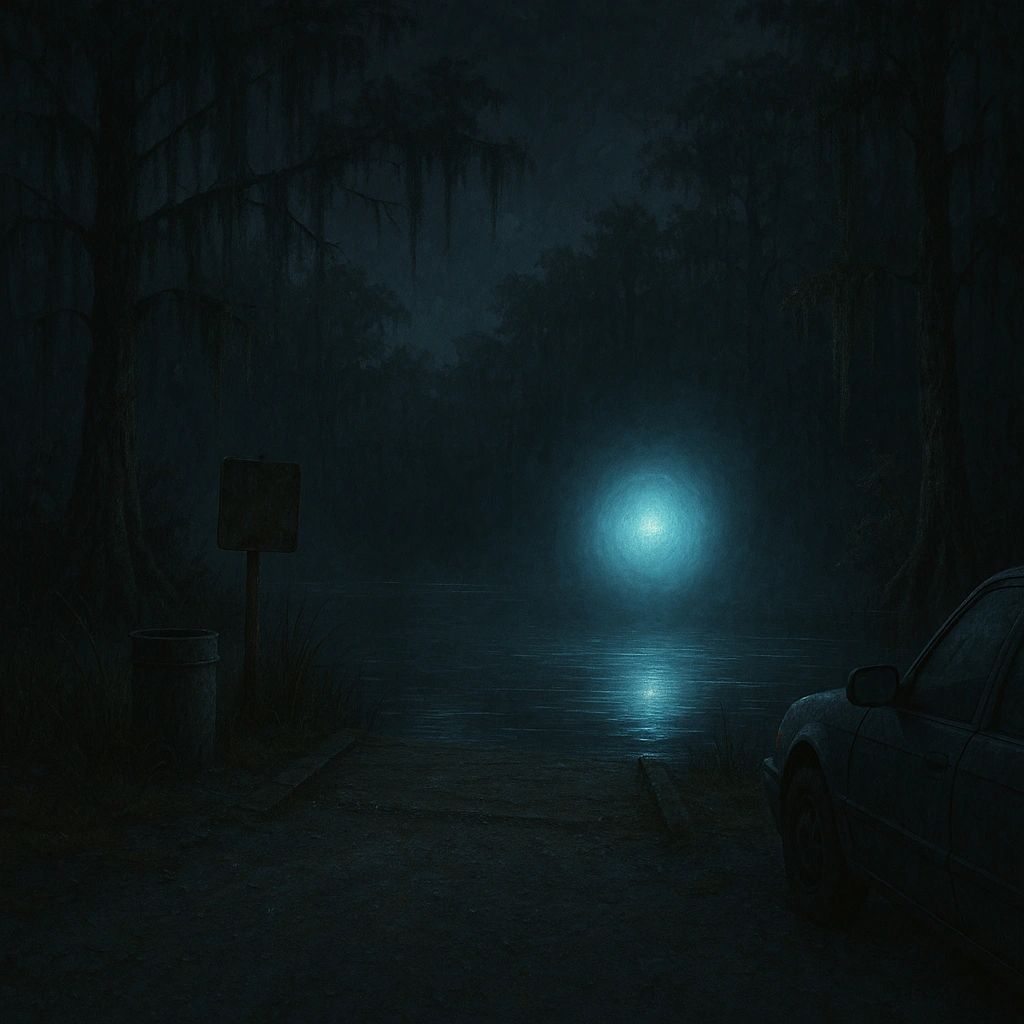
The light slips behind a stand of cypress like it’s shy—or teasing—and you ease off the gas. The road narrows, shouldered by ditch and black water. Farther on, the highway bends past a small pull-off where folks launch jon boats at dawn. At midnight, it’s a different place entirely: a concrete slope gummed with algae, a sun-faded sign riddled with birdshot, a trash barrel dented like something big leaned on it to listen.
You kill the headlights and the dark rushes in, velvet and heavy. The swamp exhales. Something plops out there—frog, turtle, or the sound of the night turning its page. You step out, gravel crunching under your shoes, and the air smells like wet wood and old leaves, a sweetness edged with rot. Spanish moss combs the breeze. The highway sings that lonely insect song—thin and endless—and for a breath, you hear another thread underneath it. A whisper. Not words, exactly. A tone, like someone humming from behind the cypress knees.
When your eyes adjust, you see it again. Not one light now. Two. They hover a foot or two above the water, paler than fire, bluer than a headlight’s hard shine. They aren’t reflections. They’re themselves. And—this is the part that tangles your gut—they seem to notice you.
“T’es fou,” your aunt would say—you’re crazy—but you lift your phone anyway. The camera finds only darkness. When you lower it, the lights have drifted apart, as if giving you room to choose. Left? Right?
In Lafourche Parish, the old stories arrive in kitchens, steaming with coffee and something frying in oil. A grandmother sets a plate, wipes her hands on a towel, and says, Listen. That’s how you learn the name: feu follet—foolish fire. Or wandering fire. Or the fire that wanders because it’s not allowed to go home.
Some say it’s the soul of the unbaptized, condemned to drift until kindness opens a door. Others say it’s a trickster, a mischief sent by spirits who don’t like their secrets disturbed. The men at the bait shop outside Bourg will tell you it’s “just swamp gas,” methane slipping out of the mud and catching a spark. They say that first, anyway. If you keep listening, they tell you other things too. About a light that followed their truck like a faithful dog, then leapt a canal without leaving a ripple. About a pair of blue lanterns that threaded through the cypress in a way no boat could go, no feet could chase, as if the woods themselves were a hallway they knew by heart.
You sit on the concrete edge of the launch and remember those voices.
There was T-Ben, who claimed the lights saved him. Fog thick as milk, bridge slick with dew, and he swore a white blaze bloomed in the middle of the span, bright enough to blind him. He stomped the brakes, heart in his throat, cussing whoever lit a flare in the lane. When his truck finally shuddered to a stop, he saw the gap—planks gone, the far rail snapped clean as a bone. “If I’d gone one more truck-length,” he said, rubbing the stubble at his jaw, “I’d be catfish meat.” He won’t drive 24 after sunset anymore. He says thank you to no one every Sunday morning.
Then there was Tante Eloise, who wore a gold cross and a smile that forgave you before you sinned. She said the feu follet were children of the between. Her words. She told you once, while the coffee went cold, that a priest in the old days refused to bless a child born too close to death. The baby lasted the night, just long enough to cry, and then the house was suddenly too quiet. That mother’s tears, Tante said, carried something out into the swamp. “Some doors slam,” she said, “and some doors swing for a long time, cher.” She believed that light was a soul waiting on a hand—one good deed, one honest prayer—to push the door wide.
And always there were the oilfield men, late shifts and hard hats, who laughed until they didn’t. One of them took a wrong turn down a service road near Larose and swore a tangerine-colored orb bobbed in his mirror for miles, keeping pace, inching closer if he slowed, drifting back if he sped up. “Like it didn’t want to lose me,” he said, eyes gone far away. “Like it wanted me to notice it was there.”
You watch the twin lights drift and think of all that—faith and failure, science and foolishness—braided into a single glow. A mosquito lands on your wrist, and you slap too late. The lights ripple. For an absurd second, you’re sure you’ve offended them.
The swamp knows its own. It recognizes trespass. On this highway, you are always a guest.
Out past the boat ramp, a flat skiff ghosts by, silent, its human shape only a suggestion against the treeline. No motor, no lantern, just the delicate push of a pole. The skiff passes through the place where the lights float—and the lights pass through the skiff, untroubled, as if both things belong to different maps layered atop each other. The person in the skiff doesn’t turn, doesn’t flinch. Maybe they can’t see what you see. Or maybe the swamp taught them long ago not to look straight at certain things.
“People make bargains out here,” your cousin once said, when the talk got late and the lights in the kitchen felt a shade too bright. “Half are with themselves. The other half…” He didn’t finish. He didn’t have to.
You think of the other stories, the ones with edges sharp enough to cut.
The girl whose boyfriend dared her to swim after the light. The way it hovered, sweet and near, then drifted just beyond fingertip reach, the way a mean older brother keeps the ball just out of your hands. She laughed and splashed and grabbed for it, and it giggled if a light can giggle, and then the giggle was a gulp, and then she was gone under the mat of duckweed and lilies, a mouthful of stems and dark water poured where air should be. They pulled her out in time, blue-lipped and shaking, and she lived to tell the story that kept her off any water after sundown for the rest of her days.
The man whose truck veered at the sight of a flare-bright blaze and found nothing in the ditch but tall grass and bottles. He said the light was angry when he didn’t follow. He said it came back into his bedroom three nights in a row, glowering from the corner like a reprimand. “My mama lit three candles and said the Prayer to St. Michael,” he told you, voice brittle. “Third night it left.” He moved to Thibodaux. He still doesn’t sleep with his back to a dark room.
The breeze shifts and carries a ribbon of sound—a child’s laugh? a bird’s call stretched thin by distance?—and the hairs along your arms stand up. The two lights bow toward each other and merge like slow smoke. What rises is a single brighter lantern. It brightens, dims, brightens again, a heartbeat pulsing in blue.
The practical mind hunts for anchors. Methane. Bioluminescent fungi threading old stumps. Distant rigs throwing their glare into moist air, bent by temperature and water into tricks. You list them like prayer beads, each explanation a bead you thumb for comfort. But the swamp is old, and your explanations are new, and the age difference makes you feel like a child repeating clever words without knowing their meaning.
Across the road, a trail leads into the cypress. Someone’s hung a little tin charm from a branch—faded red string, a bottle cap hammered flat and scratched with symbols you don’t recognize. You don’t touch it. You don’t need to touch it to know what it is. A warning. A ward. Maybe a thank-you.
You flick your headlights twice, a reflex more than a plan, and the single blue light quivers. It glides closer to the ramp, as if drawn by the sound of filament heating, as if drawn by your attention itself. You take one step back without thinking. The concrete has grown slick beneath your soles.
“Parley,” you think, absurdly. “We should parley.” As if you could negotiate with a wandering light. As if the business between the swamp and its fires is yours to handle.
And yet the stories say people do speak to them. Ask favors. Offer things—coins, bread, a prayer, a promise. In the old tales, kindness makes a light softer. Cruelty makes it burn.
“I won’t follow,” you say aloud. Your voice sounds smaller than it should. “I’ll watch, and I’ll leave you be.”
The blue orb steadies, a patient pupil. It doesn’t come closer. It doesn’t recede. It floats there at the waterline, between the earth that holds you up and the black sheen that swallows everything that forgets its footing.
Something inside you loosens, a muscle you didn’t know you were clenching. The highway hums behind you; somewhere far down it, a truck pulls a long, lonely shift of engine-brake. The night smells like rain that hasn’t decided yet.
“Tell me a story,” you whisper, and maybe you mean it for the light, and maybe you mean it for whatever listens when people finally get quiet. “Tell me why you’re here.”
What answers isn’t a voice—it’s a feeling, a hush that deepens, the swamp drawing breath to speak. Of priests and refusals. Of drowned roads and razored steel. Of lovers who promised more than they could keep. Of men with oil on their boots and women with rosaries under their pillows. Of doors that swing, and hands that hesitate, and nights when a wandering fire leaves the edge of the world a little less sharp for those who watch with care.
You stand there a long time, until the skeeters pity you and the blue light thins like fog at morning, drawing itself into a filament the size of a needle and stitching itself back into the dark.
When it’s gone, you get in the car. The dash clock blinks a time that makes no sense. You pull onto the highway and the tires hum that steady hymn.
You don’t turn the radio on. You don’t need it. The swamp has given you its song, and you’re still humming along when, in your rearview, a tiny pale glow blooms like a farewell—or an invitation you haven’t yet accepted.
You keep driving. The road ahead curls deeper into Lafourche Parish, where the air gets thicker and the stories get louder.
And somewhere out there, the lights wait where the asphalt yields to water, as patient and as hungry as the night itself.
📚 Segment Two Bibliography:Feu Follet Whispers
- Ransom, Amy. The Feminine as Fantastic in the Contemporary Quebec Novel. Rodopi, 1994. (discussion of feu follet in Francophone folklore)
- DeBlieux, Joe. “Folklore of Lafourche Parish.” Louisiana Folklore Miscellany, Nicholls State University, 1980.
- Bord, Janet, and Colin Bord. Earth Lights Revelation: UFOs and Mystery Lights Explained. Heart of Albion Press, 1992.
- McCarthy, Kevin. Ghosts of Florida’s Gulf Coast. Pineapple Press, 1997.
- Koven, Mikel J. Film, Folklore, and Urban Legends. Scarecrow Press, 2008. (analysis of will-o’-the-wisp archetype in folklore and storytelling)
About the Author
Rebecca “Madam Chronicler” Ryan is a writer and researcher for The Chronicler Library. She is the co-creator of The Chronicle of Fear and The Waterline Chronicles, and a lead researcher and contributor for The Captain’s War Chronicles and The Captain’s Cellar. Her work blends myth, history, and the natural world with empathy, insight, and intellectual rigor.
Originally published at the live site .