Folklore ·
Segment Three: Between Science and Shadows
The highway bends like a snake, and the swamp bends with it. Cypress roots gnarl out of the black water like knuckles, and the fog thickens until your headlights look like they’re drowning in milk. Somewhere in the mist,...
By Rebecca "Madam Chronicler" Ryan
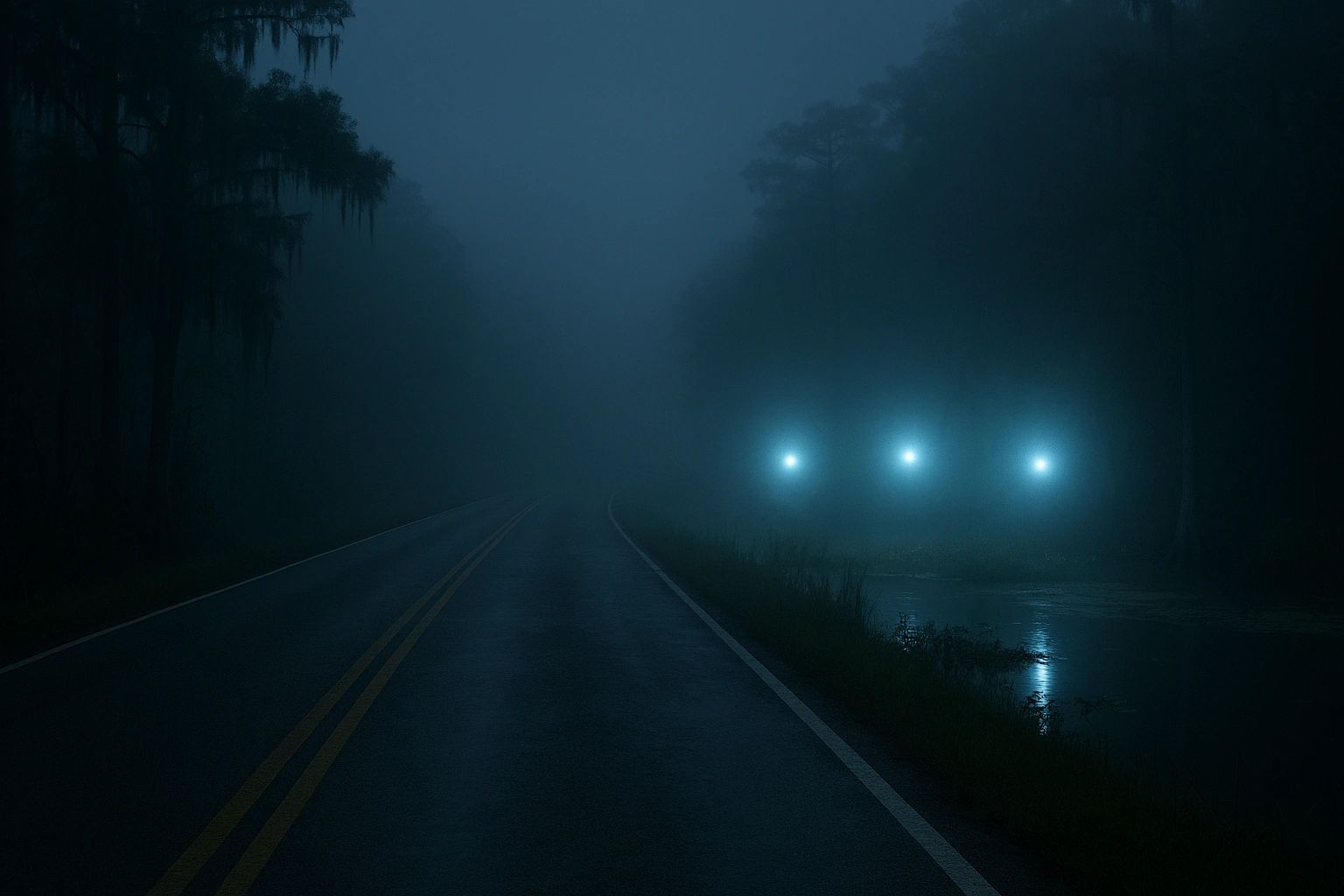
The highway bends like a snake, and the swamp bends with it. Cypress roots gnarl out of the black water like knuckles, and the fog thickens until your headlights look like they’re drowning in milk. Somewhere in the mist, a bullfrog booms a warning note, low and certain.
That’s when you see it again. Not one light this time—three. They hover in a crooked line over the marsh, like candles left behind by a funeral that never ended. You don’t brake. You don’t speed up. You just watch, every nerve in your body straining.
The lights sway as if to some unheard music, shifting, vanishing, and reappearing farther down the road. You’ve heard the stories: sometimes the lights lure, sometimes they protect. Tonight, you can’t tell which these might be.
Your mind claws for reason. Methane gas, that’s the favorite theory. Rotting plants release it, and under just the right conditions, it flickers into flame. Science even gave it a name: ignis fatuus, foolish fire. The same will-o’-the-wisp that frightened travelers across Ireland and England centuries ago.
But methane doesn’t float in a neat row, moving like lantern bearers on parade. Methane doesn’t follow cars for miles, doesn’t leap canals, doesn’t vanish when you curse it aloud. Science bends the facts until they almost fit, but not quite. Not here.
And so the swamp keeps its secrets.
It also keeps its dead.
Every local can name someone who didn’t make it home. The Bourg-Larose stretch has seen more wrecks than anyone wants to count—cars skidding on rain-slick asphalt, trucks tumbling into ditches, teenagers daring each other to drive too fast in the fog. And always, someone whispers that the lights were there first.
There was a boy named Marc, seventeen, a football player, everyone said he was headed for a scholarship. One late October night, he and his friends drove too fast through the fog. Witnesses swore a pale light hung above the curve before the bridge. Marc swerved toward it, as if it called his name. The car rolled. Two lived. He didn’t. At the funeral, his mother said she saw a blue flame outside the church window as the priest spoke the final prayer. She believed it was her boy, lingering.
And then there was the couple from Golden Meadow, returning from a wedding reception. They told friends afterward that a ball of light hovered above the center line for half a mile, keeping pace with their car. When they pulled over, the light slowed too. When they drove on, it followed. “It wasn’t headlights,” the husband swore. “It wasn’t reflection. It was something alive.” His wife never spoke of it again.
Some tragedies never make the papers, but the swamp remembers. They say the water along the highway is full of lost things—license plates, hubcaps, a school ring, even bones. Divers don’t linger long down there. They claim the visibility is near zero, and sometimes their lights don’t seem to shine the way they should. Like something swallows the beams. Like something prefers the dark.
Of course, ghost hunters came. They always do.
One group set up along the boat ramp outside Bourg in the 1990s, cameras on tripods, EMF readers blinking like Christmas trees. They brought walkie-talkies, too, but soon abandoned them. The static grew so loud they couldn’t hear each other. At midnight, one of them swore a blue orb appeared over the water and moved directly toward them. The camera batteries died at once. By dawn, they had nothing to show but shaken voices and stories that didn’t fit in daylight.
Another team came with more equipment—thermal cameras, infrared lights, even a drone. They captured something, though what it was depends on who you ask. A pale glow hovering above the swamp water, shifting in temperature but leaving no trace. Skeptics dismissed it as heat distortion, swamp gas, or a trick of moisture. Believers said it was proof the feu follet still walked the bayou. The truth, as always, slipped between the two.
And that’s the trick of the Bourg-Larose lights: they belong to neither world fully. Science bends but can’t break them. Folklore shapes them but can’t explain them away. They live in that in-between place, as much a part of the swamp as the cypress knees and the herons, as much a part of the night as your fear.
The three lights ahead of you dim, fade, and wink out, like a curtain drawing closed. The fog swallows the road again. You drive on in silence, the hum of the tires sounding too much like a heartbeat.
Somewhere far behind, you wonder if those lights are watching still.
📚 Segment Three Bibliography:Between Science and Shadows
- Bord, Janet, and Colin Bord. Earth Lights Revelation: UFOs and Mystery Lights Explained. Heart of Albion Press, 1992.
- Nickell, Joe. Adventures in Paranormal Investigation. University Press of Kentucky, 2007.
- Ancelet, Barry Jean. Cajun and Creole Folktales. University Press of Mississippi, 1994.
- Wirtz, Robert A. Louisiana’s Haunted History. Pelican Publishing, 2001.
- Harland, Paul M. Mystery Lights of the World: Folklore, Science, and the Supernatural. Blackthorn Press, 1986.
About the Author
Rebecca “Madam Chronicler” Ryan is a writer and researcher for The Chronicler Library. She is the co-creator of The Chronicle of Fear and The Waterline Chronicles, and a lead researcher and contributor for The Captain’s War Chronicles and The Captain’s Cellar. Her work blends myth, history, and the natural world with empathy, insight, and intellectual rigor.
Originally published at the live site .