
Folklore ·
Spirits of Fishermen and Oilmen of the Bourg-Larose Highwayu09ygc
The Bourg-Larose Highway runs like a dark ribbon through the swamps and marshes of Lafourche Parish, Louisiana. To outsiders, it is simply a road—an artery carrying trucks from the Gulf to the inland towns. But to locals...
By Rebecca "Madam Chronicler" Ryan
The Bourg-Larose Highway runs like a dark ribbon through the swamps and marshes of Lafourche Parish, Louisiana. To outsiders, it is simply a road—an artery carrying trucks from the Gulf to the inland towns. But to locals, it is more than asphalt and paint. It is a place where history clings, where the living pass by the dead every night without realizing it.
This is a haunted highway, one where spirits are said to walk alongside the living. The ghosts here are not the wandering aristocrats of grand plantation homes or the tragic belles of southern folklore. No, these spirits are working men—fishermen who made their living from the bayou and oilmen who sought fortune from beneath the earth. Both groups risked their lives for their families, and both often paid the ultimate price.
Their bodies may have been claimed by the Gulf, by explosions, or by accidents on rigs and boats, but their spirits are still seen—standing by the roadside, waving lanterns, dragging nets, or trudging endlessly toward worksites that no longer exist.
The Bourg-Larose Highway belongs to them, and those who travel it after dark risk more than just potholes and fog.
The Highway as a Threshold
Highways in south Louisiana are unlike those in other parts of America. Here, they cut through land that is half-water, half-earth. Cypress knees rise like tombstones from the shallows. Spanish moss sways in the humid breeze, resembling mourning veils. The road seems to float above a shifting landscape that could reclaim it at any time.
In folklore, liminal spaces—bridges, crossroads, shorelines—are believed to invite hauntings. The Bourg-Larose Highway is one such space. It is a bridge between towns, between land and sea, between the living and the dead. It carried generations of workers toward their livelihoods, but it also carried them toward their deaths.
Locals will tell you: ghosts are not bound by houses alone. They linger where they worked, where they died, and where their memories still live. For fishermen and oilmen, that place is this highway.
Ghosts of the Fishermen
Nets That Drag the Road
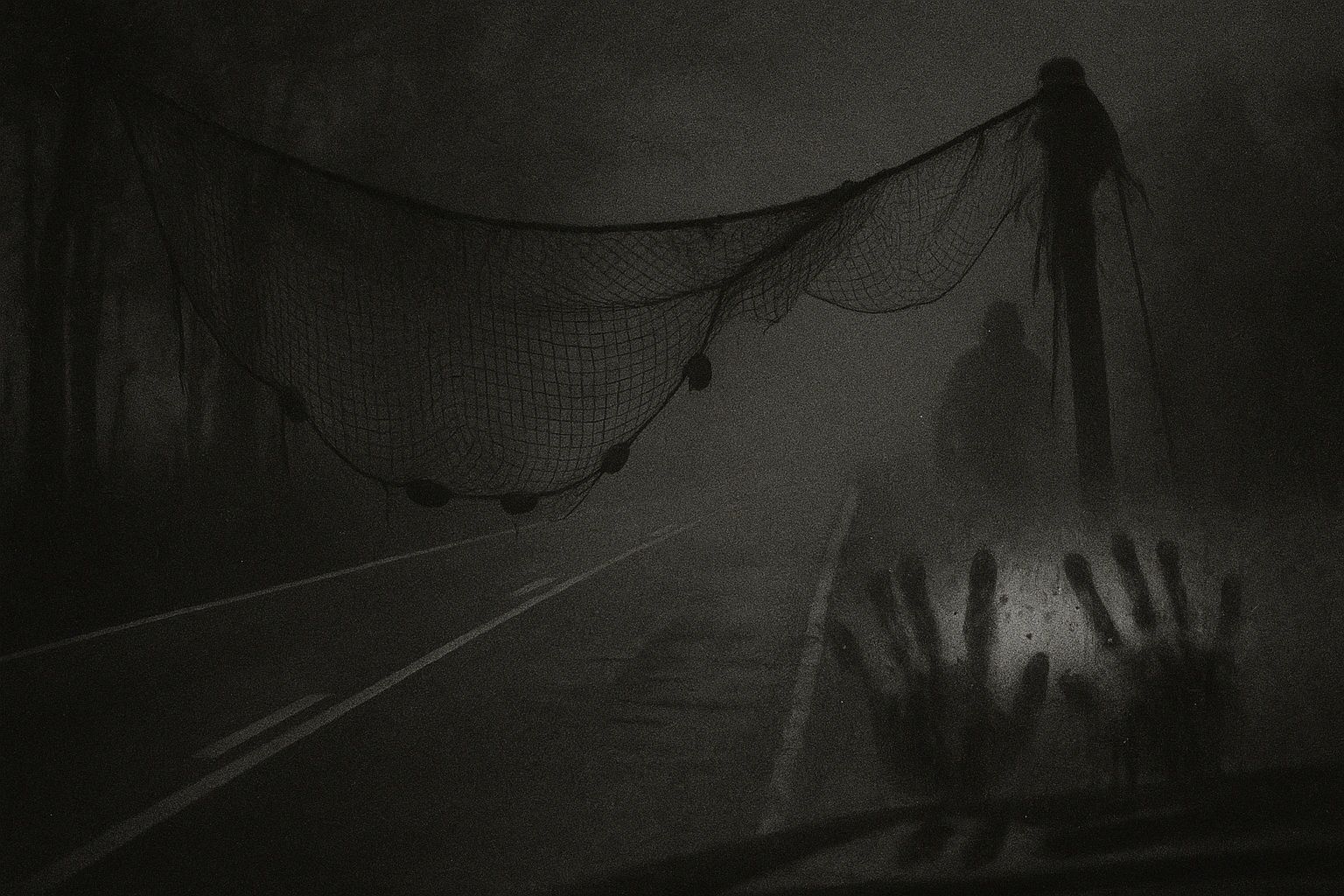
One of the oldest stories tied to the highway is that of the spectral shrimpers. On heavy fog nights, when the mist curls thick around the headlights, drivers sometimes hear scraping sounds behind them. It is said to be the sound of shrimping nets dragging across the asphalt—nets that no living man is holding.
Truckers claim to hear phantom splashes, as though buckets of shrimp are being dumped onto invisible decks. Sometimes, when they stop, they find wet streaks across the road where no vehicle has passed. A few say they’ve returned to their trucks to find dripping handprints smeared across their windshields.
To many, these sounds and signs belong to fishermen who drowned at sea, their nets forever tangled, their work unfinished.
Papa Boudreaux’s Lantern
The most famous of the fisherman ghosts is Papa Boudreaux. He was a seasoned shrimper from Bourg who went missing sometime in the 1950s. His boat was found drifting, nets half-cast, the sea alive with rotting fish. But Papa himself was gone, swallowed by the Gulf. His family never held a funeral; his body was never recovered.
Since then, countless drivers report seeing a man in a slicker and rubber boots, carrying a lantern along the shoulder of the highway. He never speaks. He never raises his head. He simply walks until a driver slows to help. Then, without fail, he vanishes. Some say the smell of brine lingers long after, the sharp tang of seawater in the middle of the marsh road.
Folklorists believe Papa Boudreaux’s ghost is tethered to the land because he never came home. His family waited for a man who never arrived, and so he still walks the road, trying to return.
The Lanterns of the Marsh
The fishermen’s spirits are also seen offshore—ghostly lanterns floating in the reeds. In the days before electric lights, fishermen relied on lanterns to guide them in the marsh. Now, people in Larose and Bourg report seeing these lights bobbing where no boats should be. When they go to investigate, the lanterns vanish, leaving only rippling water.
Skeptics dismiss them as swamp gas or will-o’-the-wisps, but locals insist they are fishermen searching for traps and lines they lost long ago.
Ghosts of the Oilmen
Hard Hats in the Dark
With the oil boom came new dangers. Men who once fished found themselves working rigs, laying pipelines, or hauling equipment. The work was brutal, the pay modest, and the risks immense. Explosions, falls, and machinery accidents claimed lives, often without warning.
Ghosts of these oilmen still walk the highway. Drivers describe seeing a man in coveralls and boots, his hard hat dangling from one hand. He walks slowly along the road’s edge, head down. If you honk or call out, he does not respond. If you stop, he vanishes. Always walking. Always toward the rigs.
One story tells of a man who saw this figure in his headlights, pulled to the side of the road, and found his truck suddenly engulfed in the smell of oil and smoke. Nothing was there, yet the odor clung to him until morning.
Convoys of the Dead
Perhaps the most chilling tales are of the phantom convoys. More than one motorist swears to have seen long lines of trucks at midnight, headlights glowing in the mist. They move in unison, stretching across the marsh road like an endless chain.
But as you get closer, the trucks fade. Their lights blink out, one by one, until the road ahead is empty. Witnesses believe these convoys belong to oilmen who died in fiery crashes decades ago, their rigs overturned, their bodies burned. They are said to be locked in an eternal journey, forever rolling toward the oilfields.
Shared Hauntings
The fishermen and oilmen spirits are sometimes seen together. One particularly eerie account comes from a fisherman’s son who was driving late at night. He saw two figures standing side by side: one in waders, dripping with water, and the other in oil-stained coveralls, a helmet under his arm.
Neither moved. Neither looked at him. They simply stood, shoulder to shoulder, as though united in silence.
To some, this symbolizes the shared fate of both communities. Whether by water or by fire, they met the same end: hardworking men who never came home.
Encounters from the Living
The Hitchhiker Who Vanished
One trucker swore he picked up a fisherman by the side of the road on a stormy night. The man climbed into his cab, soaking wet, and said only, “Drop me by the docks.” When the driver pulled over a few miles later, the passenger was gone. The seat was empty, save for puddles of water that stained the upholstery.
The Oilman in the Back Seat
Another woman, driving home from a late shift, said she looked in her rearview mirror and saw a man sitting in the back seat of her car—an oilman with a hard hat on his lap. She screamed, pulled over, and fled. When she opened the back door, no one was there. Yet she smelled oil, sharp and suffocating, in the empty car.
Whispers in Cajun French
Some claim to hear voices when they roll their windows down at night. Whispers in Cajun French float across the marsh: prayers, cries for help, or fishing songs sung low. The words are never clear, but the feeling is unmistakable—someone is still there, watching, waiting.
Why the Spirits Remain
Bound to Their Work
The fishermen and oilmen of Lafourche Parish lived by labor. Their work defined them, consumed them, and in many cases, killed them. Folklorists argue that such strong ties bind the spirit to the place of labor. These men died with nets in their hands, or with boots on their feet, and so they continue their work even after death.
The Bayou as a Gateway
In Cajun belief, water is a threshold. It reflects both life and death, a mirror of the soul. The bayou, winding and deep, is said to be a place where spirits slip between worlds. That is why drowned fishermen are seen on land and lanterns flicker where no boats are.
For oilmen, the highway itself serves as the threshold—a liminal line that carried them to their fate. Asphalt can hold memory just as firmly as water.
Cultural Memory
These ghost stories are not just entertainment. They preserve memory. The Bourg-Larose Highway is a living archive of loss and sacrifice. Fishermen and oilmen shaped the culture of Lafourche Parish, and their ghosts remind the living of the risks endured to feed families and fuel industries.
Telling their stories ensures they are not forgotten. In the whispers of the swamp, in the lantern lights on foggy nights, in the phantom convoys, the community keeps its dead alive.
Conclusion
The Bourg-Larose Highway is no ordinary road. It is a haunted memorial to working men who gave their lives to the sea and the oilfields. On its shoulders walk fishermen with dripping nets, and oilmen with hard hats, their silent steps echoing in the dark. Lanterns glow where none should, voices whisper in Cajun French, and convoys of trucks drive forever into the mist.
If you travel this highway at night, remember where you are. Roll down your window. Listen. Smell the salt, the oil, the smoke. You may be sharing the road with men who never made it home.
And if you see a lantern glowing on the shoulder, whatever you do—don’t stop.
Bibliography
- Brasseaux, Carl A. French, Cajun, Creole, Houma: A Primer on Francophone Louisiana. Louisiana State University Press, 2005.
- Fontenot, Mary. Louisiana Legends and Lore. Pelican Publishing, 1999.
- Gaudet, Marcia. Tales from the Levee: Louisiana Folklore. University of Louisiana at Lafayette Press, 2011.
- McBride, Earl. “Oilfield Deaths in South Louisiana: A Historical Survey.” Journal of Louisiana History, vol. 42, no. 3, 2012, pp. 227–248.
- Smith, Alan. “Ghost Roads of the Bayou: Folklore of the Bourg-Larose Highway.” Southern Folklore Review, vol. 18, no. 2, 2008, pp. 155–172.
- Theriot, Jerome. Bayou Spirits: Legends of Lafourche Parish. Self-published, 1987.
About the Author
Rebecca “Madam Chronicler” Ryan is a writer and researcher for The Chronicler Library. She is the co-creator of The Chronicle of Fear and The Waterline Chronicles, and a lead researcher and contributor for The Captain’s War Chronicles and The Captain’s Cellar. Her work blends myth, history, and the natural world with empathy, insight, and intellectual rigor.
Originally published at the live site .