Folklore ·
Sunland Training Center (formerly in Orlando, Florida)
Prologue – A Building with Two Lives
By Rebecca "Madam Chronicler" Ryan
Prologue – A Building with Two Lives
In the quiet twilight of Orlando’s western suburbs, at what is now near 7500 West Silver Star Road, stood a building whose moods shifted dramatically over the decades. Built in 1938 as the Florida State Tuberculosis Sanitarium (“Central Florida Tuberculosis Hospital”), it was meant to breathe fresh air and victory into the fight against tuberculosis. Florida Memory+2Abandoned Florida+2 But by the 1960s, the building’s purpose had been repurposed—rebranded as the Sunland Training Center, part of a state-run network for children and adults with severe disabilities, located in the neighborhood of Pine Hills. Clio+1
This shift marked more than a name change—it foretold a darker transformation under the weight of institutional neglect, overcrowding, and forgotten promises. From a sanitarium of hope to a haunted echo of suffering, the walls of Sunland witnessed a story that still echoes in hushed tones.
Chapter 1 – The Sanitarium of Fresh Air (1938-1960)
The original structure, dedicated in January 1938, was a PWA (Public Works Administration) era project, designed to house tuberculosis patients, at a time when fresh air, sunlight, and isolation were the chief therapies. Florida Memory+1
Photographs from that era show a long, thin, multi-winged building, with panes of windows designed to open for ventilation and sunlight. Abandoned Florida+1
It seemed, at first, a noble enterprise. But as effective antibiotics emerged and TB treatment moved elsewhere, the building’s original purpose faded. By the early 1960s, the sanitarium was idle—or at least under‐utilized.
Chapter 2 – Transition to Sunland (1961 onwards)
In 1961, the state of Florida created the Division of Sunland Training Centers, and the building in Orlando was converted into one of these institutions—specifically, the Sunland Training Center (or Sunland Hospital) for children and adults with severe mental and physical disabilities. Wikipedia+2Clio+2
These were often described as the “wards of the state” — individuals whose families relinquished rights or whose disabilities left them confined there for long durations. Clio
In its early years, Sunland bore all the trappings of an institutional facility: large wards, multiple patients per room, the promise of care, training, rehabilitation. But beneath the veneer, cracks began to form.
Chapter 3 – Cracks in the Walls: Neglect and Overcrowding
It didn’t take long for the narrative of Sunland’s decline to become visible—and alarming. By the 1970s, reports and investigations surfaced that painted a grim picture: overcrowded wards, inadequate staff, rats and pests, poorly prepared food, many patients fed via gastric tubes, surgical rooms unsanitary or makeshift. Abandoned Florida+2Finding Florida’s Phantoms+2
One former staff floor-aide described her first days:
“For two weeks after I went to work there, I couldn’t sleep because of what I saw there… Everybody who worked there saw neglect, whether they admitted it or not.” Abandoned Florida
A patient with cerebral palsy recalled waking to find a rat on her chest in a crowded ward room:
“I awoke in my 100-bed ward one night to find a large rat sitting on my chest.” Abandoned Florida
Federal records from 1972-73 include correspondence, reports, and meeting minutes under the title “Sunland Training Center” in the files of the University of Florida Special Collections. findingaids.uflib.ufl.edu
An investigative article in The Orlando Sentinel Star in May 1973 titled “Sunland Hospital: Is There No Way Out?” highlighted that “overcrowding was the single most dehumanizing condition observed” at Sunland Orlando. Clio+1
Thus, the gilded promise of care was overshadowed by systemic neglect, institutional isolation, and the suffering of those too vulnerable to fight back effectively.
Chapter 4 – Lawsuit, Closure, and Abandonment
By 1978-79, a turning point arrived when the Association for Retarded Citizens of Florida (ARC) filed a class-action lawsuit on behalf of six patients (“the Sunland Six”) alleging that Sunland failed to provide adequate facilities and services. Clio+1
The pressure mounted, inspections were conducted, and the state began to close down the Sunland institutions—in Orlando the doors eventually closed in the early 1980s (some sources say 1983; others cite final operations into 1985). Clio+1
Left abandoned, the site deteriorated. The empty corridors, peeling paint, wheelchairs and hospital beds left behind, the echo of human voices in large, empty wards—these all became fodder for rumor, dare, and urban exploration.
Chapter 5 – A Fatal Fall and the Ghost Stories Begin
In June 1997, one of the most chilling modern events tied to the Sunland site occurred. A 23-year-old man exploring the abandoned building with friends plunged down an elevator shaft and was critically injured. Abandoned Florida+1
Strangely, a sheriff’s deputy responding to the scene reported seeing a young boy looking out of a second-floor window of the site—though no such boy was found. Orlando Haunts+1
This incident accelerated the push by the local community in the Pine Hills neighborhood for demolition of the dangerous structure. By 1998–1999 the main building was razed; today only the administration building remained (for a while) and a playground covers part of the site. Orlando Haunts+1
And with abandonment came stories: swings moving by themselves after dark, ghostly figures of children in wheelchairs, cries echoing in the night. One haunt-tour blog described the sight of a wheelchair moving down a hallway and a black shadow figure in an upstairs window. Florida Haunted Houses
Chapter 6 – The Haunting – What Survivors and Explorers Report
Ghost-hunting websites, local lore, and personal testimonials have kept the chilling legacy alive. Here are recurring themes:
- Apparitions or shadows of children wandering the playground or building where Sunland stood. Orlando Haunts+1
- Unexplained sounds: screaming, moaning, gurneys rolling, whispers in corridors. Finding Florida’s Phantoms
- Objects moving on their own: swings shifting, wheelchairs rolling, lights flickering. Florida Haunted Houses
- A feeling of “evil” or deep sadness: visitors say the place “feels wrong.” Florida Haunted Houses
Whether one believes in ghosts or not, the stories carry weight because of the documented human suffering that occurred there.
Chapter 7 – The Playground Today, and Memorials of the Past
What stands there now? The site has been redeveloped, leaving little of the original hospital structure. According to the Florida Memory archives, the building located at West Silver Star Road was later destroyed in 1999 after years of disuse. Florida Memory+1
At nearby Greenwood Cemetery in Orlando, Section Q contains the graves of more than 100 Sunland patients—many children who died at the facility and whose existence is quietly memorialized. Clio+1
One visitor’s note:
“The innocent-looking playground hardly has any reminders of the tragedies that once took place here. Though, at night, ghosts of the children come out to play.” Orlando Haunts
In some ways, the playground is an apt metaphor—children at play atop the grave site of childhoods lost, lives truncated, voices unheard.
Chapter 8 – Story-Form Narrative: Walking the Halls of Memory
Imagine you’re arriving at the site of the old Sunland building as dusk fades into night. The air is thick with humidity; even the breeze feels weighed down by the past.
You push open the wire gate (now long removed, but you recall someone telling you it once squealed on old hinges) and step onto the cracked pavement. To your left, the empty administration building looms; to your right, grass and trees reclaim where the main hospital wing once was.
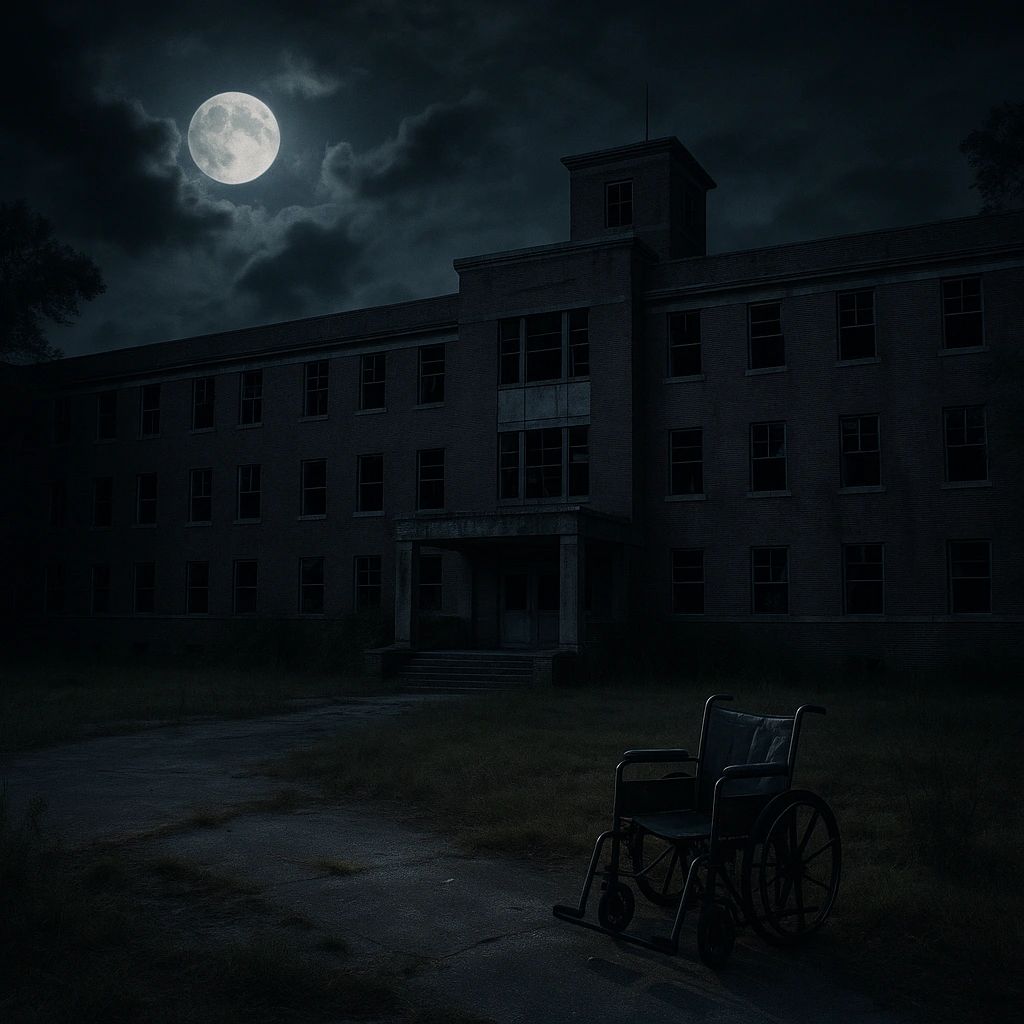
You wander under the dappled streetlamps to the faint echoes of children’s laughter—maybe it’s real, maybe not. You enter a hallway: plaster falling, tiny shards underfoot, the smell of stale must and rot hangs. You glance around: a wheelchair, rusting, abandoned. You touch the wall—it is cold, damp, the paint peeling in sheets.
A corridor forks ahead; you choose the left branch. Your flashlight flickers. You hear something: a soft wheeze, a cough, perhaps. You pause. And then ahead, the silhouette of a small figure at the window. Your heart thumps. You holler—but no answer.
Then the silence: heavy, sorrowful. You remember the reports: 100 patients in one ward; rats crawling over bodies; feeding-tubes and gruel. You recall the lawsuit, the staff who couldn’t sleep for weeks. You sense the presence of the unseen.
You exit into the night. Behind you, the playground where once children were confined, now swings sway in the still air—though you didn’t touch them. You don’t stay long. You leave, and behind you the building stands, now demolished, but its echoes linger.
Chapter 9 – Reflections: Why This Place Matters
The haunting of Sunland isn’t just about ghost stories—it’s about memory and justice. It’s about the millions of people with disabilities who were institutionalized and forgotten; about those whose lives were compressed into beds, tubes, wards, out of sight.
The echoes remain: in the files of the University of Florida archives of Sunland Training Center, 1972-73. findingaids.uflib.ufl.edu In the Orlando Sentinel investigations of the 1970s. Clio+1 In the graves of Section Q at Greenwood Cemetery, with children whose names maybe “Baby Boy Bell,” who died at age 2. Clio
These are primary sources: the archival correspondence, the photographs, the newspaper investigations, the cemetery records. They anchor the story in fact, not just lore.
And when a place becomes “haunted,” perhaps it is less about ghosts and more about memory that refuses to disappear. The building may be gone, but the stories don’t fade. The playground is cheerful by day—but by dusk the air chills, not because of the wind, but because of what was and what was not.
Chapter 10 – A Ward’s Whisper: Voices from the Past
In a quiet moment, imagine the voice of a former patient or aide:
“Every morning we lined up. Breakfast was cereal-gruel through a tube. The wards smelled of disinfectant and urine. The windows often didn’t open properly. I heard screaming one night—maybe a patient, maybe a staff member. My memory is foggy, but the fear is vivid.”
Or the aide:
“I couldn’t sleep for two weeks. I saw bodies loaded onto trucks, I heard ‘clunk’ when they turned people over on hard slabs for baths. We were told we were here to help; we couldn’t.”
These are not fictional lines—they reflect the testimonies found in investigations and archival records. Their whispers remain.
Epilogue – The Haunted Afterlife
The dark legacy of Sunland Training Center lives on—through urban exploration, ghost tours, local storytelling, even in the seemingly innocuous swings of a playground at dusk. The site reminds us of a time when society hid its vulnerable away, when “care” often meant confinement, and when voices left unheard now speak through memory and whispers.
If you pass near the old Sunland site at twilight, stop. Look at the field, the shadows between the trees. Listen for a creak, a sigh. Maybe you’ll hear the echo of a child, a wheelchair rolling, a plea for recognition. Because that, perhaps, is the true haunting—not the ghost of a person, but the ghost of accountability, memory, and the promise of dignity unfulfilled.
Sources / Primary References:
- Photograph “Florida State Tuberculosis Sanitarium – Orlando, Florida.” State Archives of Florida, Florida Memory. Florida Memory
- “Sunland Training Center, 1972-1973.” Special & Area Studies Collections, University of Florida. findingaids.uflib.ufl.edu
- Newspaper investigation: “Sunland Hospital: Is There No Way Out?” Orlando Sentinel Star, May 6 1973. Clio
- Abandoned Florida: “Sunland Mental Hospital Orlando | 40+ Photos.” Abandoned Florida
- “Sunland Hospital Site | Orlando FL Haunted Place.” FloridaHauntedHouses.com. Florida Haunted Houses
About the Author
Rebecca “Madam Chronicler” Ryan is a writer and researcher for The Chronicler Library. She is the co-creator of The Chronicle of Fear and The Waterline Chronicles, and a lead researcher and contributor for The Captain’s War Chronicles and The Captain’s Cellar. Her work blends myth, history, and the natural world with empathy, insight, and intellectual rigor.
Originally published at the live site .