
Folklore ·
The Haunted Bourg-Larose Highway: Ghosts of Lafourche Parish
Louisiana’s bayou country is a land where the veil between the living and the dead often feels thin. Fog rises from the swamps like spirits climbing from their watery graves, Spanish moss hangs heavy from the cypress tre...
By Rebecca "Madam Chronicler" Ryan
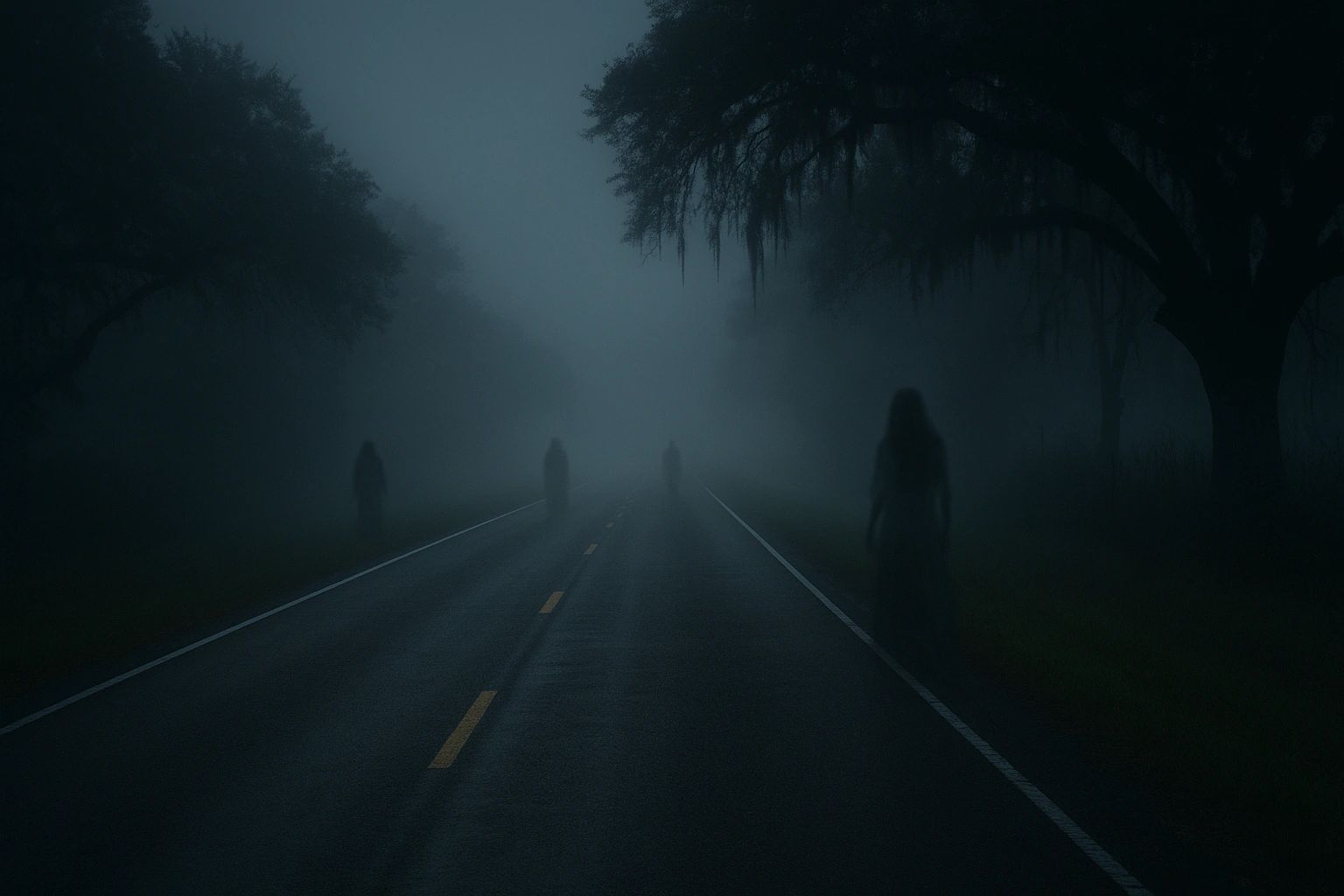
Louisiana’s bayou country is a land where the veil between the living and the dead often feels thin. Fog rises from the swamps like spirits climbing from their watery graves, Spanish moss hangs heavy from the cypress trees, and stories echo across generations about things that move in the night. Among the highways and backroads that cut through this mysterious landscape, none has earned a more chilling reputation than the Bourg-Larose Highway in Lafourche Parish.
Officially designated Louisiana Highway 24, the Bourg-Larose Highway winds through fishing villages, sugarcane fields, and swamplands. To outsiders, it may look like any other rural stretch of road. But locals know better. Strange lights, phantom hitchhikers, wandering spirits of drowned fishermen, and even the ghostly remnants of Cajun funerals are said to appear here.
The Bourg-Larose Highway is more than asphalt and gravel—it is a haunted corridor where the living and the dead seem to cross paths.
A Highway Born from the Bayou
To understand why this stretch of road might be haunted, we must first understand its roots. The Bourg-Larose Highway follows ancient pathways once used by Native Americans long before European settlement. The Chitimacha and Houma tribes navigated these lands by pirogue, traveling the bayous that weave through Lafourche and Terrebonne Parishes.
When the Acadians—later known as Cajuns—arrived in the 18th century after being exiled from Nova Scotia, they settled along these waterways. Their lives were built around fishing, trapping, farming, and faith. Yet life was never easy. Hurricanes destroyed villages, floods swept away homes, and epidemics tore through families. Many early settlers died young, and the swamps became their silent resting place.
By the 20th century, the Bourg-Larose Highway was paved, offering a land-based connection to Houma, Larose, and beyond. But the land beneath it had already absorbed centuries of tragedy and toil. Some believe the restless spirits of those who lived and died here never left—and now wander the very road built above their graves.
The Phantom Hitchhiker
Perhaps the most famous ghost story tied to the Bourg-Larose Highway is that of the phantom hitchhiker. Drivers traveling the highway late at night often claim to see a figure on the roadside, sometimes a woman in white, other times a fisherman in worn boots, thumbing for a ride.
Witnesses describe pulling over, only for the figure to vanish before their eyes. Others say the ghost enters the vehicle silently, sitting in the back seat, only to disappear before the driver reaches the next town.
One Lafourche Parish legend tells of a young woman from Bourg who died in a car accident on her way home from a dance in the 1950s. Locals believe her spirit still walks the Bourg-Larose Highway, searching for a ride back home. Truckers swear they’ve seen her along the road in the thick fog, and many refuse to drive the highway alone at night.
Ghost Lights in the Swamp
The swamps along the Bourg-Larose Highway are known for eerie, floating lights—sometimes called feux follets or swamp will-o’-the-wisps. These mysterious orbs of light dance across the marshes, luring travelers deeper into the wetlands.
In Cajun folklore, the feux follets are believed to be spirits of the dead or mischievous entities that lead the living astray. Old-timers warn that if you follow these lights, you may never return. On foggy nights, drivers along the Bourg-Larose Highway report seeing strange orbs hovering just beyond the tree line, flickering like lanterns carried by ghostly hands.
Scientists may dismiss them as swamp gas igniting, but locals know better—the bayou keeps its secrets, and these lights are one of them.
Spirits of Fishermen and Oilmen
The Bourg-Larose Highway is not only a cultural artery for Cajun families—it is also an economic lifeline, leading to Port Fourchon and the Gulf of Mexico. Fishermen, shrimpers, and oilfield workers travel it daily. Sadly, not all of them made it back home.
Many lives have been lost to boating accidents, oil rig explosions, and hurricanes. It is said that the spirits of these men wander the Bourg-Larose Highway, trying to make their way back to their families. Drivers tell of seeing shadowy figures trudging along the roadside with fishing nets slung over their shoulders, only to fade into the mist when approached.
Some even say you can hear the faint sound of footsteps on the pavement when no one is there, as though unseen workers are still walking their eternal shift.
The Funeral Processions
Another chilling tale tied to the Bourg-Larose Highway involves phantom funeral processions. In Cajun tradition, funerals were deeply significant events, often involving music, prayers, and long lines of cars or horse-drawn wagons following the deceased to their final resting place.
Witnesses claim that on certain nights, a spectral line of headlights appears in the distance, slowly approaching. As it nears, the lights suddenly vanish, leaving only silence and darkness. Older residents believe these are echoes of past funerals, replaying on the highway as the spirits of the dead return to be mourned once more.
The Woman in White
Louisiana is full of tales of the “woman in white,” and the Bourg-Larose Highway is no exception. Drivers have reported seeing a pale woman in a flowing dress walking along the road or standing beneath the oak trees.
Some believe she is the ghost of a young bride who drowned in the bayou on her wedding night. Others say she is the restless soul of a mother searching for her lost child. Whatever her origin, the sight of her has caused more than one driver to swerve off the road in shock.
Folklore Blended with Faith
What makes the Bourg-Larose Highway’s hauntings unique is how they intertwine with Cajun Catholic faith and folklore. In South Louisiana, belief in the supernatural runs deep, mixing French Catholic traditions with older Native American and African influences.
Many residents carry rosaries or hang crucifixes in their cars for protection while traveling. Priests have even been called to bless parts of the highway after fatal accidents. Yet, despite these protections, the stories of hauntings persist—proof that the people of Lafourche Parish accept the supernatural as part of their daily lives.
Hurricanes and Tragedies
Hurricanes have left their mark on the Bourg-Larose Highway, both physically and spiritually. Storms like Hurricane Betsy (1965), Hurricane Andrew (1992), Hurricane Katrina (2005), and most recently Hurricane Ida (2021) devastated the region, claiming lives and homes.
Many believe the souls of those lost during these storms linger on the highway. In the quiet after a hurricane, when the air is heavy with salt and ruin, some locals claim to see ghostly figures standing silently on the roadside, as if surveying the wreckage of their former lives.
A Road of Life and Death
The Bourg-Larose Highway is more than a haunted road—it is a living, breathing reflection of Cajun Louisiana itself. It carries fishermen to work, children to school, and families to festivals. But it also carries the weight of tragedy, from car crashes to hurricanes, and that energy lingers.
Every mile of the highway seems to hold a story. Some are joyful, like weddings and Mardi Gras parades. Others are tragic, like fatal accidents and untimely deaths. Together, they weave a tapestry of memory that refuses to fade.
Why Is It Haunted?
Ghost hunters often ask: Why do certain places become haunted? For the Bourg-Larose Highway, the answer lies in a combination of factors:
- Tragedy – Generations of accidents, storms, and drownings have left countless untimely deaths along this stretch of land.
- Cultural Belief – The Cajun people’s acceptance of spirits and folklore allows ghost stories to flourish and endure.
- The Land Itself – Swamps, fog, and isolation create the perfect backdrop for supernatural encounters.
It is no surprise that a road built upon such history would carry whispers of the past into the present.
Modern Encounters
Even today, drivers continue to report strange experiences on the Bourg-Larose Highway. Paranormal investigation groups have set up equipment along the roadside, capturing unexplained voices and flickering lights. Hunters and fishermen returning home late at night tell stories of shadowy figures darting across the road, only to vanish.
One recent account comes from a young couple driving home from Larose. As they passed a stretch of highway near Bourg, they saw a man standing in the middle of the road. The driver swerved to avoid him, but when they looked back, the road was empty. Shaken, they refused to travel that way at night ever again.
The Highway as a Haunted Landmark
The Bourg-Larose Highway may never appear in glossy travel brochures, but for those fascinated by Louisiana’s haunted history, it is a must-visit. It embodies everything eerie about the bayou: the mist, the silence, the sudden sounds of the unseen.
For ghost hunters, folklorists, and thrill seekers, this stretch of road is a reminder that the past is never truly gone. It lingers in the land, the water, and the asphalt beneath our wheels.
Conclusion
The Bourg-Larose Highway in Lafourche Parish is more than a road—it is a haunted passage through time. Every ghost story, from the phantom hitchhiker to the woman in white, is a reflection of the struggles, tragedies, and traditions of the people who call this land home.
To drive the Bourg-Larose Highway at night is to experience Louisiana at its most mysterious—a place where the living and the dead still travel side by side. The headlights of your car may pierce the fog, but the shadows that lurk just beyond remain, waiting for the next traveler to pass.
In the end, whether you believe the tales or not, the Bourg-Larose Highway teaches one lesson: the bayou remembers. And sometimes, it reminds us that we are not as alone on the road as we think.
Bibliography
- Brasseaux, Carl A. The Founding of New Acadia: The Beginnings of Acadian Life in Louisiana, 1765–1803. Louisiana State University Press, 1987.
- Brasseaux, Carl A. Acadian to Cajun: Transformation of a People, 1803–1877. University Press of Mississippi, 1992.
- Gaudet, Marcia G. Tales from the Levee: The Folklore of St. Landry Parish. University Press of Mississippi, 1984.
- Gauthreaux, Kevin. “Ghost Stories from Bayou Country.” Louisiana Folklore Miscellany, vol. 14, 2002, pp. 22–39.
- Henry, Jacques, and Carl L. Bankston III. Blue Collar Bayou: Louisiana Cajuns in the New Economy of Ethnicity. Praeger, 2002.
- Lafourche Parish Historical Society. A History of Lafourche Parish. Thibodaux, LA, 1995.
- Newton, Michael. Encyclopedia of Cryptozoology and Paranormal Folklore of the South. McFarland, 2016.
- Nickell, Joe. Entities: Angels, Spirits, Demons, and Other Alien Beings. Prometheus Books, 1995.
- Oubre, Glenn R. Louisiana Hurricanes from the Colonial Era to Katrina: A History of Hurricanes in Louisiana. LSU Press, 2008.
- Smith, Glenn R. “Phantom Hitchhikers and Other Roadside Legends in Louisiana.” Journal of American Folklore, vol. 89, no. 354, 1976, pp. 202–213.
- Sublette, Ned. The World That Made New Orleans: From Spanish Silver to Congo Square. Lawrence Hill Books, 2008.
- U.S. Department of Transportation, Louisiana Department of Highways. History of Louisiana Highway 24. Baton Rouge, LA, 1971.
- Waller, George M. Ghosts of the Bayou: Louisiana’s Haunted Roads and Legends. New Orleans: Pelican Publishing, 1999.
- Westbrook, Laura. Haunted Louisiana: Ghosts and Strange Phenomena of the Bayou State. Stackpole Books, 2010.
About the Author
Rebecca “Madam Chronicler” Ryan is a writer and researcher for The Chronicler Library. She is the co-creator of The Chronicle of Fear and The Waterline Chronicles, and a lead researcher and contributor for The Captain’s War Chronicles and The Captain’s Cellar. Her work blends myth, history, and the natural world with empathy, insight, and intellectual rigor.
Originally published at the live site .