
The Haunting of McRaven House: Mississippi’s Most Haunted Home
In the heart of Vicksburg, Mississippi, where the past still clings to the humid air and cannon echoes from the Civil War seem to linger just beyond hearing, stands a house that time refuses to forget. Locals call it McR...
By Rebecca "Madam Chronicler" Ryan
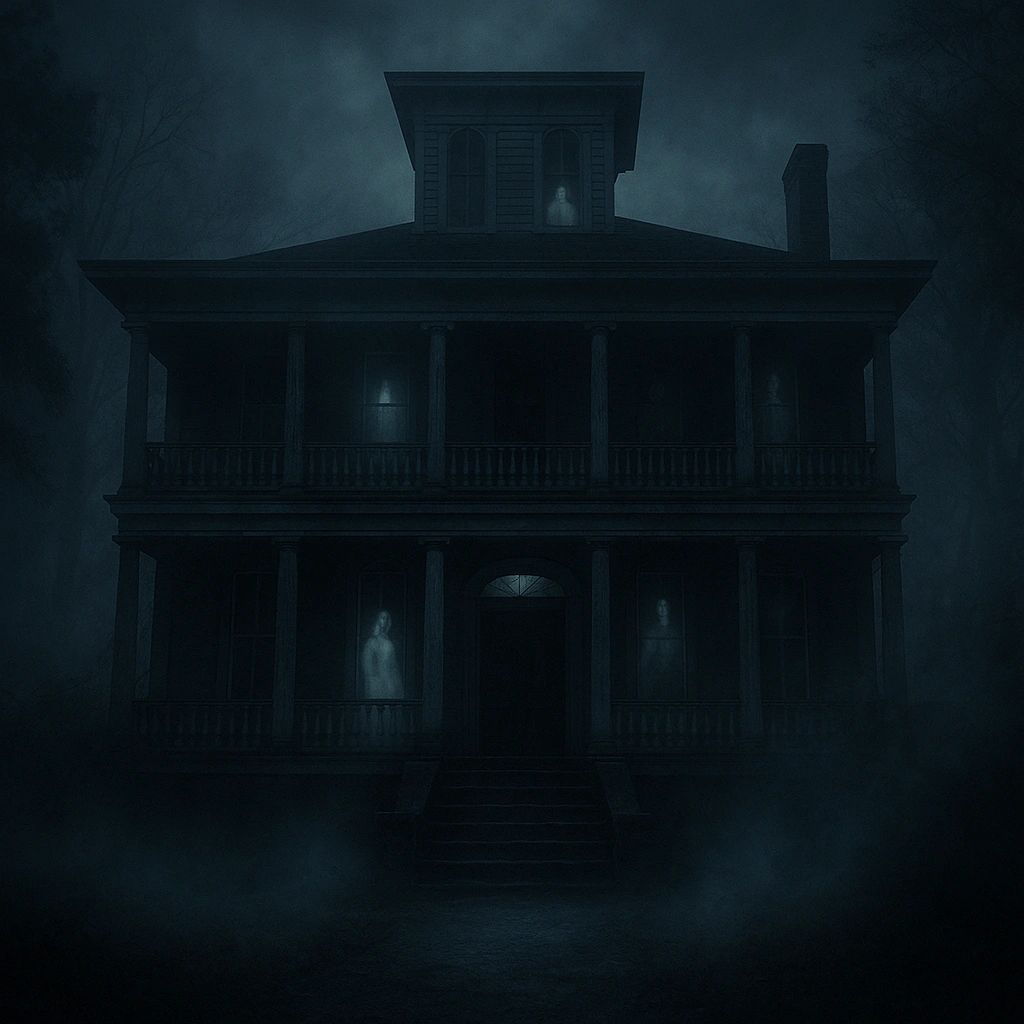
In the heart of Vicksburg, Mississippi, where the past still clings to the humid air and cannon echoes from the Civil War seem to linger just beyond hearing, stands a house that time refuses to forget. Locals call it McRaven House, but many whisper another name — “The Time Capsule of the South.” Its bricks, wood, and glass have absorbed nearly two centuries of triumph, tragedy, and terror.
If you listen closely on still nights, you might hear the sound of footsteps on the old staircases or the rustle of skirts sweeping across the parlor floor. And if you’re unlucky — or perhaps lucky — you might catch a glimpse of one of the many restless souls who have never quite left.
A House Built in Layers of Time
McRaven House isn’t like most old Southern homes. It’s a living architectural timeline, a structure that grew and evolved as the centuries passed — and perhaps, with each new addition, gathered more spiritual residue from the lives (and deaths) within.
The house began humbly in 1797, when a highwayman named Andrew Glass built a small, two-room brick dwelling at the edge of what was then a rough frontier settlement along the Mississippi River. The home’s design was simple, almost primitive — one room downstairs, one above, with a narrow staircase.
Glass was a violent man, and according to legend, he used his modest home as a hideout for stolen goods and a refuge from lawmen. When a posse finally tracked him down, Glass took his own life rather than be captured. His blood, some say, stained the original floorboards — a dark omen for what was to come.
In 1836, Sheriff Stephen Howard purchased the home. He added a new Greek Revival section, complete with elegant columns and wide windows overlooking the garden. His wife, Mary Elizabeth Howard, adored the house. She filled it with laughter, fine furnishings, and the scent of magnolia blossoms.
But happiness was fleeting in those days. In 1838, Mary Elizabeth died in childbirth, her final screams echoing through the walls as a thunderstorm raged outside. Visitors still claim to hear a woman’s anguished cries from the upstairs bedroom — the room where she took her last breath.
The final major expansion came in 1849, when John H. Bobb, a successful businessman and Confederate sympathizer, bought the home and transformed it into an Italianate masterpiece. He added a grand staircase, ornate woodwork, and wide galleries perfect for entertaining.
But even grandeur could not save McRaven from what was coming.
The War Comes to Vicksburg
In 1863, the Civil War reached Vicksburg with brutal precision. The city became a fortress under siege — bombarded day and night by Union forces. Civilians dug caves into the hillside to escape the shelling, and starvation swept through the population.
John Bobb, loyal to the Confederacy, found himself caught between duty and survival. When Union soldiers entered Vicksburg after the city’s surrender on July 4, 1863, tensions ran high. One day, a Union patrol arrived at McRaven to confiscate property. Accounts differ, but what’s known is that a confrontation ensued — and Bobb was shot dead on his own front porch.
His wife, Selina Bobb, was left to mourn in silence as blood darkened the steps. Today, those steps remain — weathered, but still standing — and many claim that if you stand there long enough, you can feel a sudden drop in temperature, as though his ghost still guards the threshold.
The House That Refused to Die
Time moved on. The war ended. But McRaven House seemed suspended between eras. The Bobb family continued to live there for a while, then it passed through different hands, each leaving behind a trace of their own life — and, perhaps, their own ghost.
By the early 20th century, the home had fallen into disrepair. Its windows were broken, vines crept across the façade, and its grandeur faded. Yet even as the structure aged, stories persisted. Locals spoke of lights flickering at night when no one was inside. Others reported a figure in antebellum dress standing at the upstairs window, staring out toward the city as though waiting for someone who would never return.
During restoration efforts in the 1960s and 1970s, workers reported tools moving on their own, footsteps echoing in empty rooms, and cold spots that lingered for hours. Some even refused to return after sunset.
It was around this time that McRaven earned its reputation as Mississippi’s Most Haunted House.
The Spirits Within
Today, McRaven is not only a historic landmark but also one of the most active paranormal sites in the South. Ghost tours, investigations, and TV crews have all come to experience the strange energy within its walls.
And while many spirits are said to inhabit McRaven, three are the most frequently encountered — Andrew Glass, Mary Elizabeth Howard, and John Bobb.
The Outlaw: Andrew Glass
The oldest ghost in McRaven’s history is also its most elusive. Witnesses describe hearing heavy boots pacing the lower floors, or the sound of a door slamming violently when no one is nearby. Paranormal teams have captured EVPs — electronic voice phenomena — that sound like a man muttering or cursing under his breath.
One investigator once asked aloud, “Who’s here with us?” A male voice replied through static: “Glass.”
Some visitors report a shadow figure darting through the original 1797 portion of the home — tall, broad-shouldered, wearing what looks like a cloak or long coat. Others claim to feel a burning sensation on their neck or chest, as though scratched by invisible hands.
Could it be Andrew Glass still guarding his hideout, unwilling to surrender even after two centuries?
The Lady of the House: Mary Elizabeth Howard
Her story is perhaps the most heartbreaking of all. Pregnant and radiant with anticipation, Mary Elizabeth’s joy turned to agony as complications during childbirth claimed her life and her infant’s. Her spirit, it seems, could not move on.
Guests often report seeing a glowing figure drifting through the Greek Revival wing — soft, white, and graceful. The scent of rosewater and lilac sometimes fills the air, even when no flowers are nearby.
Others hear the faint melody of a music box, or the soft hum of a lullaby coming from the upstairs bedroom — the same one where she died.
One tour guide once said:
“She’s not angry. She’s just… lonely. Like she’s waiting for someone to come home.”
The Fallen Patriarch: John Bobb
Of all McRaven’s spirits, John Bobb may be the most restless. His violent death on the front steps seems to have bound him to the home forever.
Visitors have witnessed a figure in 19th-century attire standing near the doorway or pacing the veranda. Sometimes, he appears only as a shadow — other times, as a full-bodied apparition. He’s known to knock over objects, slam doors, and even whisper to guests.
Paranormal investigators have captured EVPs of a man’s voice shouting “Get out!” — always near the front entrance where he died.
But perhaps the most chilling story comes from a local historian who was cataloging artifacts in the parlor one evening. She felt a sudden chill, then saw — reflected in the glass of a framed portrait — a man standing behind her, his face stern and pale. When she turned, the room was empty.
The Civil War Room
One of the most active areas in McRaven is known as the Civil War Room — a chamber filled with artifacts, uniforms, and relics from the Siege of Vicksburg.
Visitors often report a sense of overwhelming sadness there, as if the weight of the war still hangs heavy in the air. Cameras malfunction, batteries drain instantly, and disembodied voices have been recorded on multiple occasions.
One EVP captured by a paranormal team in 2018 recorded a faint male voice saying, “Don’t fire — don’t fire…” followed by the sound of cannon fire, though no cannons exist anywhere near the home today.
Others have claimed to see a Confederate soldier limping through the hallway, his face pale and eyes hollow. He vanishes before reaching the parlor, as if fading back into another time.
The House That Bends Time
There’s a reason McRaven is called “The Time Capsule of the South.” Each section of the home — from the frontier 1797 brickwork to the 1836 Greek Revival elegance to the 1849 Italianate splendor — feels like stepping into another century.
Some paranormal researchers believe that this layering of eras has created a vortex of spiritual energy, trapping echoes of every life that ever passed through.
Time doesn’t flow normally here. It folds. It bends. And sometimes, it bleeds.
Visitors report feeling disoriented when passing from one wing to another. Watches stop. Electronic devices glitch. One guest claimed that her phone clock jumped backward three hours while standing in the old stairwell — then corrected itself the moment she stepped outside.
Another said she heard voices speaking in old dialects she didn’t understand — until she realized they were coming from the empty air around her.
Encounters That Defy Explanation
McRaven’s reputation has drawn countless paranormal investigators over the years — from independent researchers to TV shows like Ghost Adventures and Haunted History. The results have been staggering.
- Thermal cameras have recorded human-shaped heat signatures walking through empty rooms.
- Motion sensors have been triggered without explanation.
- EVPs have captured names, laughter, and even cries for help.
- Furniture has moved inches at a time between recordings.
One of the most famous photographs taken in the house shows a translucent woman standing behind a group of tourists in the upstairs hallway. The group swore no one else was present when the photo was taken.
Even skeptics have left shaken. A journalist visiting in 2019 admitted afterward:
“I don’t believe in ghosts. But I’ll never forget that cold breath on my neck — when there was no one behind me.”
Nightfall at McRaven
When dusk settles over Vicksburg and the cicadas fall silent, McRaven transforms. The air grows heavy, and the shadows lengthen across the old garden paths.
Tour guides lock the gates, but those who remain for the overnight investigations speak of strange happenings. Lights flicker, footsteps echo in the hallways, and unseen hands brush against the living.
One investigator reported hearing a woman sobbing in the upstairs hallway, only to find every room empty. Another swore she saw a man’s reflection in the mirror — though she was alone in the parlor.
The bravest guests sometimes spend the night. Few last until dawn.
Legends Never Die
What makes McRaven so haunting isn’t just its ghosts — it’s the way the house itself seems to remember. Every crack in the plaster, every creak of the floorboards feels alive with memory.
This home has witnessed frontier crime, young love, war, death, and sorrow. And through it all, it has stood — a silent observer of history’s darkest moments.
Perhaps that’s why McRaven continues to draw visitors. It’s not just curiosity that brings them. It’s connection — the unspoken desire to reach across the veil and touch the past, to hear the voices of those who refused to be forgotten.
And maybe, in that echo between worlds, we find a reflection of ourselves.
Visiting McRaven Today
Today, McRaven House operates as both a museum and a haunted attraction. Visitors can tour the property during the day to learn about its architectural evolution, or return at night for the ghost tours that have made it infamous.
Guides carry lanterns through the dim corridors, telling stories of Andrew Glass’s outlaw hideout, Mary Elizabeth’s final moments, and John Bobb’s fatal encounter. It’s not just storytelling — it’s reliving.
And many guests leave with more than memories. They leave with questions. With shivers. With a sense that something followed them home.
Why McRaven Still Haunts Us
The haunting of McRaven House isn’t merely about restless spirits — it’s about the human need to preserve the past, even when that past refuses to rest.
Each ghost is a story unfinished. Each sound in the night is a fragment of history calling out for remembrance.
When you walk through McRaven, you don’t just walk through a house — you walk through time itself. And somewhere in that timeless space, between life and death, the spirits of Vicksburg still whisper their stories.
Maybe that’s why, even after two centuries, McRaven House remains alive — not with life as we know it, but with the pulse of everything that came before.
Bibliography
- McRaven Tour Home Official Site. “History of McRaven House.” McRaven House Museum, Vicksburg, MS.
- Mississippi Department of Archives and History. “The Siege of Vicksburg and Its Civilian Impact.”
- Haunted South: The Ghosts of Vicksburg. Southern Heritage Press, 2018.
- Travel Channel. “Most Haunted Homes in the American South.”
- Ghost Adventures. McRaven House Investigation Episode Transcript, 2013.
- Vicksburg Post Archives, 1863–1901. “Accounts of the Death of John H. Bobb.”
- Southern Gothic: Tales of the Haunted South. New Orleans Folklore Press, 2020.
About the Author
Rebecca “Madam Chronicler” Ryan is a writer and researcher for The Chronicler Library. She is the co-creator of The Chronicle of Fear and The Waterline Chronicles, and a lead researcher and contributor for The Captain’s War Chronicles and The Captain’s Cellar. Her work blends myth, history, and the natural world with empathy, insight, and intellectual rigor.
Originally published at the live site .