
Folklore ·
The Lighthouse Keeper’s Tale
Introduction
By Rebecca "Madam Chronicler" Ryan
Introduction
Cape Canaveral has long been a place where humanity looks both to the sea and the stars. Today, the name conjures images of rockets, astronauts, and the launchpads of the U.S. space program. But before NASA claimed the Cape, it was a place of danger, shipwrecks, and isolation.
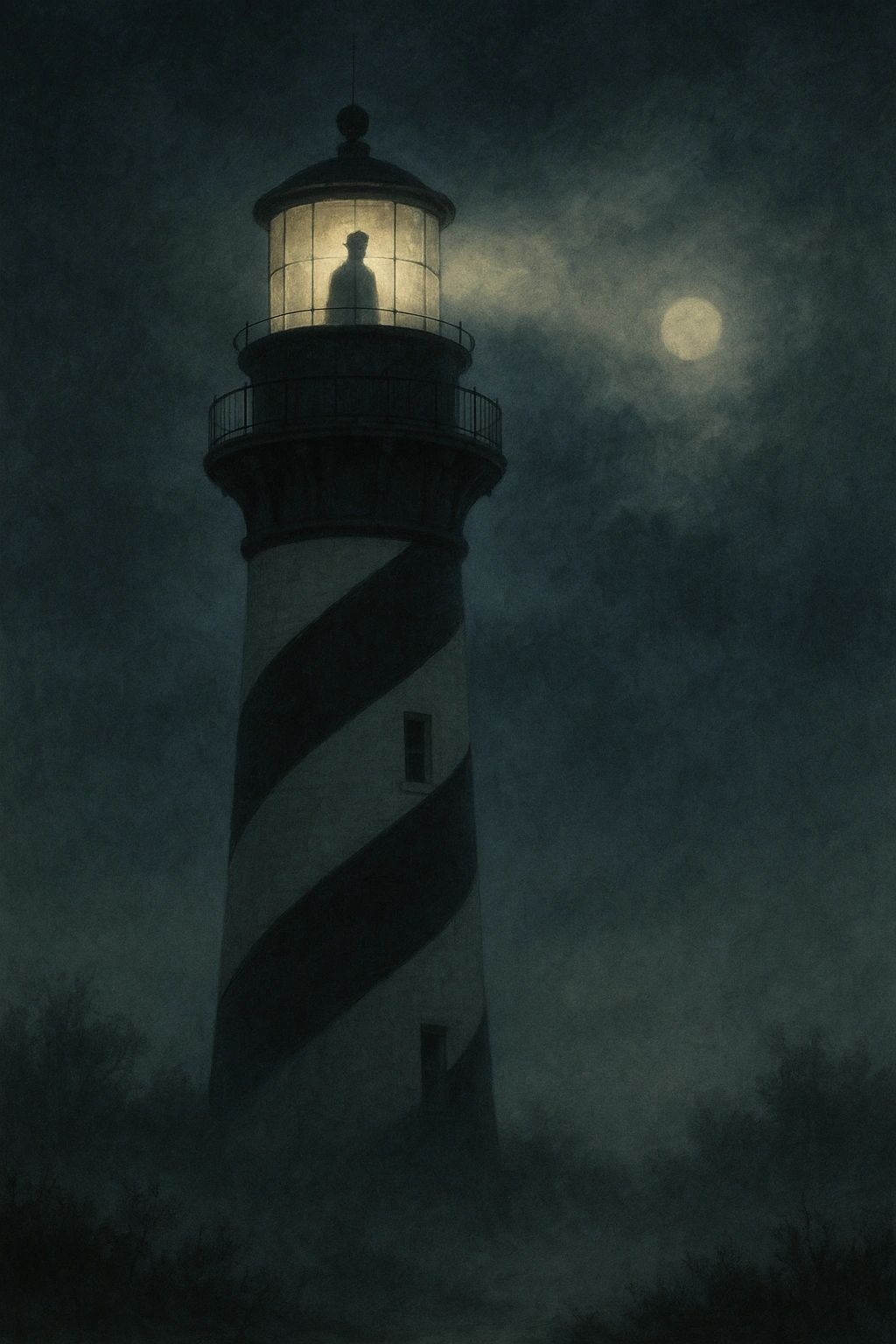
Standing watch over this treacherous coast is the Cape Canaveral Lighthouse—the only fully operational lighthouse owned by the U.S. Space Force. Its white-and-black-striped tower rises above the dunes, a beacon that has saved countless sailors since its first light in 1868.
Yet, like all lighthouses, Cape Canaveral has a darker tale. Its keepers lived with loneliness, storms, and the endless roar of the Atlantic. Whispers of phantom footsteps, restless spirits, and tragedies that never left the shore echo through its history.
This is The Lighthouse Keeper’s Tale: Cape Canaveral’s Haunted Beacon.
Chapter 1: The Birth of a Lighthouse
Before the Cape Canaveral Lighthouse, Florida’s east coast was a graveyard of ships. Hidden shoals, shifting sandbars, and violent storms dashed vessels against the shore with terrifying regularity. Mariners called the area the “Florida Reef”, a stretch infamous for wrecks.
In 1848, the first lighthouse rose on the Cape. Made of brick and standing 65 feet tall, it was fitted with a fixed light to warn sailors. But its position proved poorly chosen. Built too close to the waterline, it was vulnerable to erosion. Within two decades, the sea had nearly claimed it.
In 1868, the original tower was dismantled brick by brick and rebuilt further inland—taller, stronger, and more resilient. This is the lighthouse that still stands today, 151 feet tall, its powerful beacon visible for over 20 miles.
Chapter 2: The Keeper’s Life
Life at Cape Canaveral was as isolated as it was harsh. Keepers and their families had little contact with the outside world, save for occasional supply runs. The Florida wilderness pressed in around them—mosquitoes, rattlesnakes, and the constant threat of hurricanes.
The keepers tended the light with absolute dedication. They climbed the spiral staircase multiple times a day to polish the massive Fresnel lens, refill oil lamps, and later, maintain the kerosene and electric systems. Each night, the beacon had to shine without fail. A single lapse meant disaster.
Children of the keepers grew up surrounded by the sea and sand, often making their own fun in the isolation. Wives shouldered the burden of loneliness, sometimes acting as assistant keepers themselves. The ocean was both neighbor and enemy.
And in the silence of the dunes, many reported feeling an unease—like eyes upon them, like the lighthouse itself was never truly empty.
Chapter 3: Ghosts on the Cape
The Cape Canaveral Lighthouse has its share of ghostly lore, born from centuries of shipwrecks and tragedy.
One tale speaks of phantom sailors, souls from wrecked ships who never reached shore. Locals have claimed to see shadowy figures moving along the beach near the lighthouse, lanterns in hand, searching for salvation that never came.
Others whisper of a keeper who never left his post. According to legend, one of the 19th-century keepers, devoted to his duty, collapsed in the lantern room during a violent storm. Though his body was buried inland, his spirit is said to linger. Visitors report flickers of movement near the lens, and some have sworn to hear bootsteps echoing on the iron staircase when the tower is empty.
The isolation, the tragedies of the sea, and the devotion of the keepers have fueled the belief that Cape Canaveral is not merely a place of light—but also of shadows.
Chapter 4: Storms and Sacrifice
Florida’s storms are legendary, and the Cape has faced more than its share. Hurricanes battered the lighthouse across centuries, rattling windows and shaking the very foundations of the tower.
In 1886, a massive storm swept across the Cape, flooding the keeper’s quarters and nearly extinguishing the light. Records tell of keepers working through the night, waist-deep in water, determined to keep the flame alive. They succeeded—but at great cost to their health and sanity.
Some stories suggest that not every keeper survived the fury of the sea. One tale tells of a young assistant swept away by storm surge while checking the grounds. His body was never recovered, and some claim he still walks the shoreline, forever bound to the sea he served.
Chapter 5: War and Watchtowers
During World War II, the Cape became a critical defense site. The lighthouse was darkened at times to prevent it from aiding enemy submarines lurking offshore. Keepers were joined by military personnel, and the once-isolated tower became part of the war effort.
It was during this time that new tales emerged—soldiers stationed near the lighthouse spoke of eerie lights moving across the dunes, only to vanish when pursued. Some believed these were German spies signaling to U-boats. Others whispered that they were the spirits of long-dead sailors, still seeking rescue.
The line between history and haunting blurred, as it so often does at places where tragedy and duty collide.
Chapter 6: From Sea to Space
In the 1950s, Cape Canaveral transformed. The U.S. government established the missile testing range that would become Cape Canaveral Space Force Station and, later, Kennedy Space Center. Rockets replaced ships as the Cape’s primary symbol.
The lighthouse suddenly found itself surrounded not by wilderness, but by launchpads. Yet, it remained—a sentinel of the old world in a landscape of futuristic ambition.
Workers and visitors alike reported strange happenings. Engineers testing rockets late at night claimed to see a figure moving in the lighthouse lantern room, though no keeper was stationed there. Security guards on patrol heard phantom footsteps crunching through the sand. Some even suggested that the restless spirits of shipwrecked sailors now watched the rockets, as if transfixed by humanity’s new journey across a different kind of sea—the sea of stars.
Chapter 7: The Keeper’s Legacy
By the late 20th century, the lighthouse was automated, and the keepers were gone. Yet, the stories persisted.
Today, the Cape Canaveral Lighthouse is preserved by the Cape Canaveral Lighthouse Foundation, which offers tours and shares its history. It stands as the only operational lighthouse owned by the U.S. Space Force, an enduring symbol of both maritime safety and America’s leap into space exploration.
But while its history is celebrated, its haunted past is never far away. Guests sometimes speak of cold drafts on the stairs, or the sensation of being followed as they ascend. Guides tell the stories of phantom sailors, restless keepers, and tragedies lost to the sea.
The Cape Canaveral Lighthouse is more than a landmark—it is a monument to duty, sacrifice, and the thin line between history and haunting.
Chapter 8: Symbol of Light and Darkness
The lighthouse is a paradox. It represents salvation for sailors, yet despair for those who served it. It is a place of light, yet a magnet for ghost stories. At Cape Canaveral, this duality is even sharper.
Here, the past collides with the future. A tower built for sailors now watches over astronauts. A flame that once guided wooden ships now stands beside rockets piercing the heavens. And in the midst of this, the legends remain.
To visit Cape Canaveral Lighthouse is to feel both wonder and unease. The salt air carries the scent of history. The Atlantic roars with the same fury it always has. And somewhere, perhaps in the shadows of the lantern room, the lighthouse keeper still watches.
Conclusion: The Light Still Burns
The Cape Canaveral Lighthouse is not only a relic of maritime history—it is a keeper of stories. Some are heroic, others tragic, and a few are undeniably haunted.
It is a place where duty stretched beyond death, where phantom lights flicker in the mist, and where the sea still whispers to those willing to listen.
Though rockets now dominate the Cape, the lighthouse endures as a reminder of humanity’s oldest struggle: the fight to survive the darkness. Its light still burns. And so do its legends.
This is The Lighthouse Keeper’s Tale: Cape Canaveral’s Haunted Beacon.
Bibliography
- Dolin, Eric Jay. Brilliant Beacons: A History of the American Lighthouse. W. W. Norton & Company, 2016.
- Noble, Dennis L. Lighthouses & Keepers: The U.S. Lighthouse Service and Its Legacy. Naval Institute Press, 1997.
- Stott, Carole. The Lighthouse Encyclopedia: The Definitive Reference. Globe Pequot Press, 2003.
- Roberts, Bruce. America’s Lighthouses: An Illustrated History. Globe Pequot Press, 1989.
- Cape Canaveral Lighthouse Foundation. canaverallight.org
- U.S. Space Force Public Affairs. “History of Cape Canaveral Lighthouse.”
- Florida Memory Project, State Archives of Florida. “Cape Canaveral Lighthouse Records.”
- Varner, Gary R. Haunted Lighthouses: Phantom Keepers, Ghostly Shipwrecks, and Sinister Calls from the Deep. Pinewood Press, 2008.
About the Author
Rebecca “Madam Chronicler” Ryan is a writer and researcher for The Chronicler Library. She is the co-creator of The Chronicle of Fear and The Waterline Chronicles, and a lead researcher and contributor for The Captain’s War Chronicles and The Captain’s Cellar. Her work blends myth, history, and the natural world with empathy, insight, and intellectual rigor.
Originally published at the live site .